
 Honey walking in snowThe vigor of Lily’s cubs shows that Lily is still providing good nutrition with weeks to go before she will eat a substantial meal. The cubs’ job is to eat (nurse), sleep, and grow. When they are not sleeping or nursing, they are bundles of activity, exploring the snow-free parts of their world, playing, and just keeping busy.
 Cub tries walking on snow!Tonight, as we were writing this update, the cubs were inside the den playing and Lily stood outside and looked around, raised her nose in the air, and licked. Was she catching the scent of fattening buds?
Later she returned to the den and the cubs ventured out. To our surprise, they tested the snow and found they could walk on it.  Cubs explore new heightsPerhaps Lily and her cubs will leave before the snow does.
Jewel’s family is cooped up in a small den that doesn’t have the recreational advantages of Lily’s tangle of twigs.
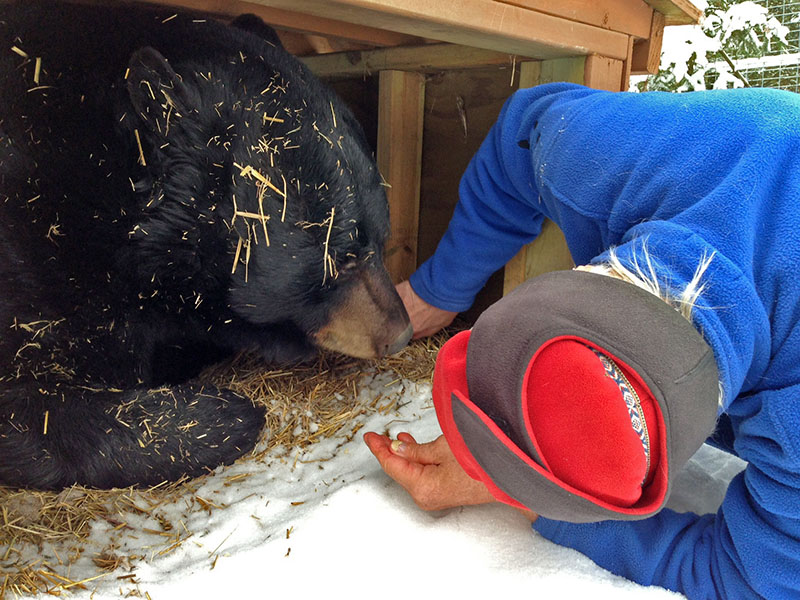 Lynn touches Ted's footpadsAt the Bear Center, we wondered if there was a difference in the footpads of Lucky, Ted, and Honey that would explain the differences in their willingness to get out and walk in the snow. We know that new footpads can be tender and even bleed from walking on crusty snow—like we've had the last few days. We checked the pads of Ted, who is most reluctant to get out and go.
  Ted's footpadsHe reacted to touching his pads and firmly asked Lynn not to do that. But when we invited Ted to the fence, he readily stood up and hooked his claws on the wires so we got a good look at his pads. He still has a good portion of his old pads.
  Lucky's footpadsIn the picture, the old pad in the center appears mushy while the new pad toward the edges is firm. This may well be why he walks so cautiously on the crunchy snow.
On to Lucky. We asked him to stand up and show us his paws, too. He did—even more readily than Ted. He has entirely new firm pads.
 Lucky stands at fenceNext, we asked Honey. She didn’t show her pads quite as nicely as Ted and Lucky did, but her main pad is all new. She seems to still have some old footpad on her toes, but we believe we can see areas where she has chewed bits off. We'll be documenting the progress of their pads over the next few weeks.
 Honey's footpadsWe doubly wondered about Ted and Honey shedding footpads because the only report of bears shedding footpads came from our study area here in the north, Shedding of foot pads by black bears during denning available at http://tinyurl.com/Shedding-Footpads. We wondered if bears that may have genes from other areas do the same. We wondered that because we saw Honey walking gingerly on old thickened footpads in the summer. Same for Ted. Now we see that Ted and Honey are both shedding theirs. Just another thing for the Bear Center staff to observe and record.
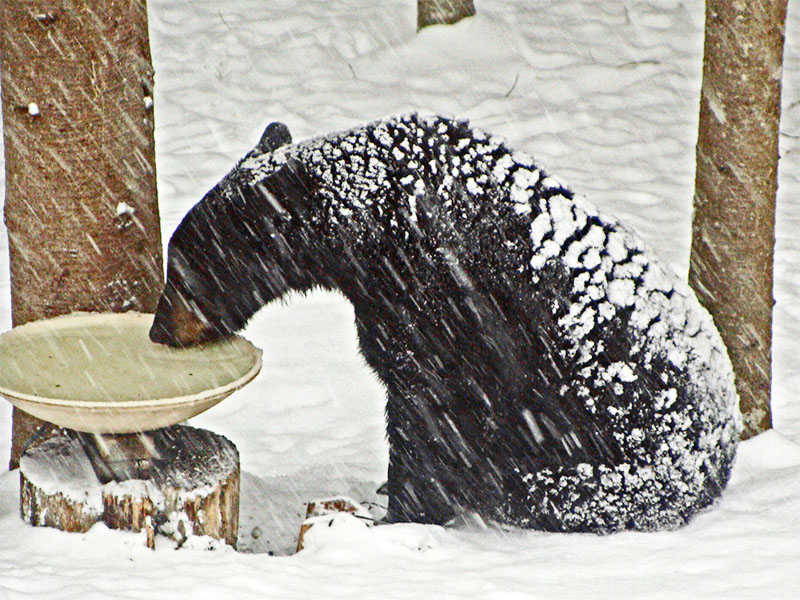 Bear drinking from birdbathLast night’s update about the bears not wanting to gulp water on a shrunken stomach spurred a Lily Fan to send a picture of a bear that they have been feeding for a couple weeks already this spring. The picture is from maybe a hundred miles south of here. The bear now eats everything available and drinks heartily from the heated birdbath. What a difference a stretched stomach makes.
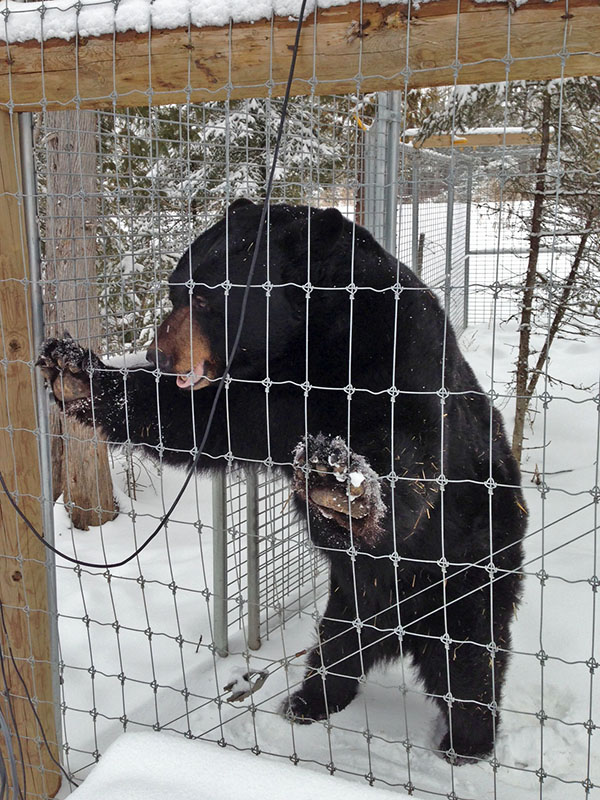 Ted stands up against fenceWe’re being cautious not to over-feed Ted, Lucky, and Honey and stretch their stomachs prematurely. That would lead to more hunger, more feeding, and excess weight gain at this unnatural time of year. That, in turn, would cause the veterinarians on our USDA permit to holler at us for overfeeding, as they have done in the past. We were really glad to see Ted lean enough today to stand up against the fence like we have hardly seen him do.
 Ellie and LilyWe’re moving toward castrating Lucky. This was not an easy decision to make. We thought long and hard. We want to show as natural behavior as possible so visitors can learn by watching. But a young adult male with teeth, driven by hormones, might be more natural than Ted wants to deal with in the confines of the 2+ acre pen. The safety of the bears is our paramount concern.
 Eli licks snowWe talked to the manager of a bear rescue facility, which has about 80 bears. All the males there are castrated and are fine. We talked to the veterinarian who reportedly has castrated more black bears than anyone in the world. He did it as part of a study at Rutgers University.
  An incoming cub!He has had no problems. He says the circulating testosterone dissipates in a couple weeks. He and his veterinarian associate will fly here to work with the local veterinarians as soon as they can. We want to do the operation as far before mating season as possible so testosterone levels can have time to dissipate before Honey shows estrus.
  Cub plays slothWe know Lucky well. It will be interesting to see the changes in his habits and drives.
PTZ video footage of Lily and cubs from yesterday is Part I https://www.youtube.com/watch?v=NtGroN8B95E, Part II https://www.youtube.com/watch?v=-gxgDpPNKlc, and Part III https://www.youtube.com/watch?v=MIujvjfGraU.
Our hearts go out to the Boston Marathon bombing victims and their families.
Thank you for all you do.
—Lynn Rogers and Sue Mansfield, Biologists, Wildlife Research Institute and North American Bear Center
All photos taken today unless otherwise noted.