
 Lots of yawning these days What a difference a year makes. The snow today in this fairly normal year made us look back to the record early spring of last year when things were happening about a month earlier than usual.
The March 27 ice-out on Shagawa Lake last year was the earliest ever recorded—when the average ice-out date is April 27. The latest ice-out for Shagawa was May 16 in 1996—following the coldest winter on record.
 Eli and Lily nose to noseLast year, snow disappeared in mid March with temperatures in the 60’s to high 70’s. Juliet and her cubs were flooded out of their den before the cubs could walk.
By March 21, bears were roaming. 2-year-old Sharon was 0.6 miles from her den, and Jo and her yearling Victoria were a third of a mile from theirs—tipping over rocks looking for food that wasn’t there yet. Juneberry buds were bursting. Loons were flying over, and ducks were returning to the open water of Woods Lake outside our window.
 Lily and cubsBy March 24, red maple flowers were open.
By March 25, robins were back and a great-blue heron was fishing by our dock. 2-year-old Shirley was active 1.5 miles from her den. We caught up to her and removed her radio-collar to comply with the collar limit on our permit.
 Eli heads for the cameraBy April 3, deer were eating new green grass by the Research Center and bears were eating new grass shoots in wetlands. But the record early spring and green-up led to trouble for bears and people when temperatures returned to normal in April and vegetation growth stalled under nighttime temperatures as low as 15F. Late frosts on May 9, 10, 11, 12, 16, 21, and 31 damaged blossoms and hurt berry production.
 Eli blocks the light so it flips to IRLast year, May was a month of hunger. In the towns of Tower and Soudan—where bears weren’t provided with diversionary food—bears roamed the streets and backyards looking for bird feeders and garbage. Radio-collared Jo was shot in Soudan the night of May 21. We found her body in the woods the next morning. Non-radio-collared bears roaming those towns may have met the same fate, but without radio-collars, no one would know.
 Camera gets thorough inspectionDespite the frosts, berry production in some areas looked promising until the drought. Bear problems could have been even worse, but the drought gave a boost to the ant reproduction. Bears concentrated in clearcuts where they found logs to tear open and sunny rocks to turn over. The radio-collared bears pretty much stayed out of trouble between the clearcuts and the diversionary feeding in the Eagles Nest Community.
 Lily eyes EllieThis year (2013), with conditions more normal and snow helping to replace the depleted ground-water from several years of drought, we are hoping for good bear food to keep all bears out of trouble. Rainfall is always unpredictable, of course, but hopefully it is at least normal.
 Lily eyes EliThe biggest wild card is tent caterpillars. A month-long outbreak in May or June could occupy the bears but outbreaks also destroy ground plants and defoliate berry bushes, creating summer food shortages. Some experts are saying the coming outbreak won’t happen until 2014. We can only wait and see and keep our fingers crossed for good food this year.
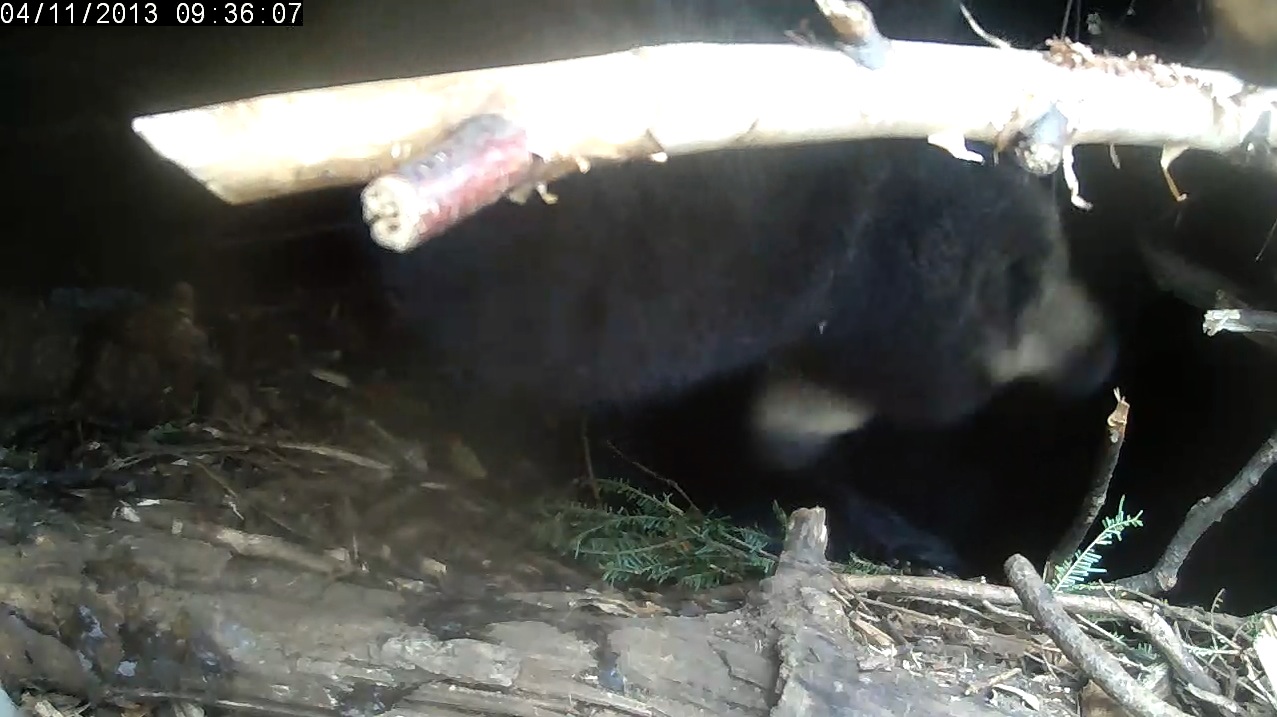 Who put tracks on the ceiling?Last night at 8:05:17 PM, something scared Lily and she lunged and blew—more bluster than we have seen from her all winter. Then she began to grunt as if concerned for her cubs. As near as we can make out, Ellie scampered out of the den and up into a hole at the top of the den. The hole doesn't lead directly down into the den but rather into an 'attic' above the main den. At 8:06:25—after some noisy scrambling above—Ellie falls into the back of the den with a plunk. Watch the video of it at http://youtu.be/9qpfIak-yPE and see what you think. Watch for the shadow of a mouse roaming around, too!
Videos of Lily and cubs from today are Part I http://youtu.be/sU3S99eC7bs, and Part II http://youtu.be/Z5ZLDcNY9Pg.
Thank you for all you do.
—Lynn Rogers and Sue Mansfield, Biologists, Wildlife Research Institute and North American Bear Center
All photos taken today unless otherwise noted.