
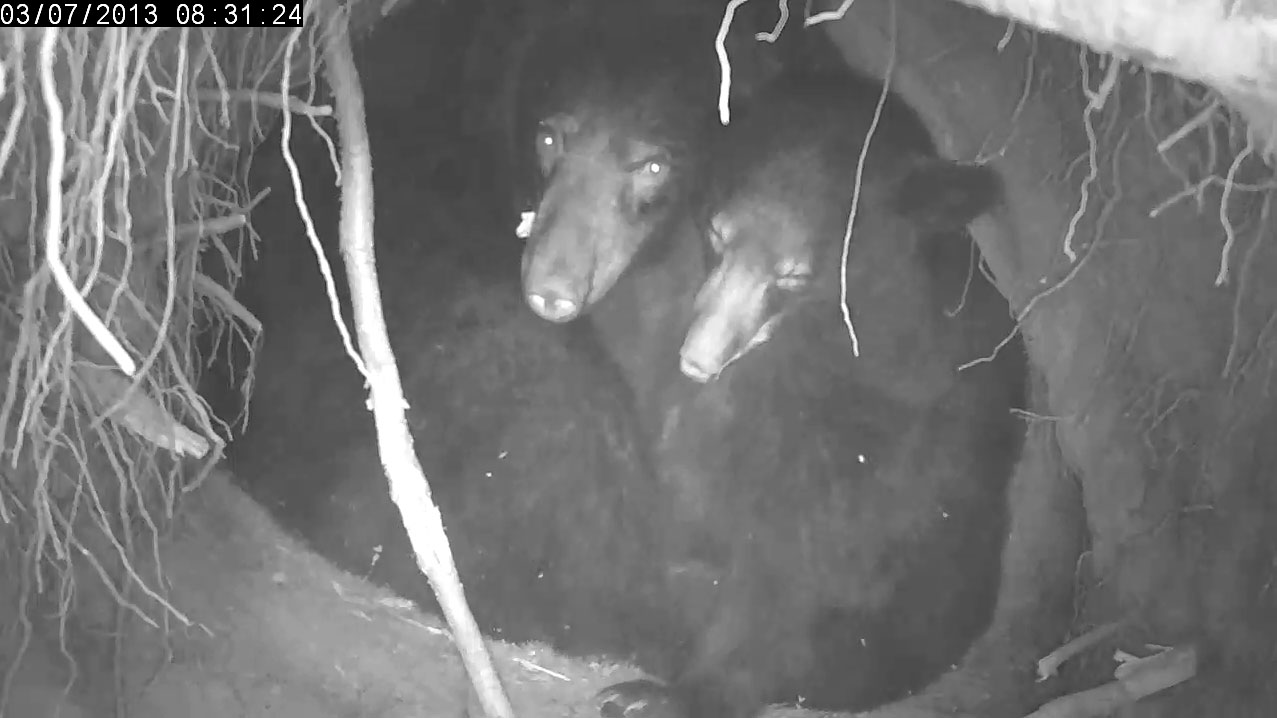
 Jewel and Fern Whenever we hear of kids’ excitement about the bears, we get excited, too. Sometimes their excitement is because of the Den Cams; sometimes it’s the updates—or classroom teachers telling about these bears, or a Lily Fan giving a talk. The Speakers Bureau will widen the circle of dissemination. TV documentaries have helped. Getting the word out is what we’re all about. We learn from the bears and then share the data with everyone we can. Getting feedback from the kids reminds us why we do what we do and it reflects what Lily Fans have done to expand the possibilities.
The new book we mentioned last night, “Bear Encounters: True Stories to Entertain and Educate,” is in the Gift Shop at http://www.bear.org/website/books/product/7718-bear-encounters.html. The publisher made a final selection of 79 bear stories from Lily Fans. We imagine children getting a more realistic idea of what black bears are like from hearing these true stories as bedtime stories.
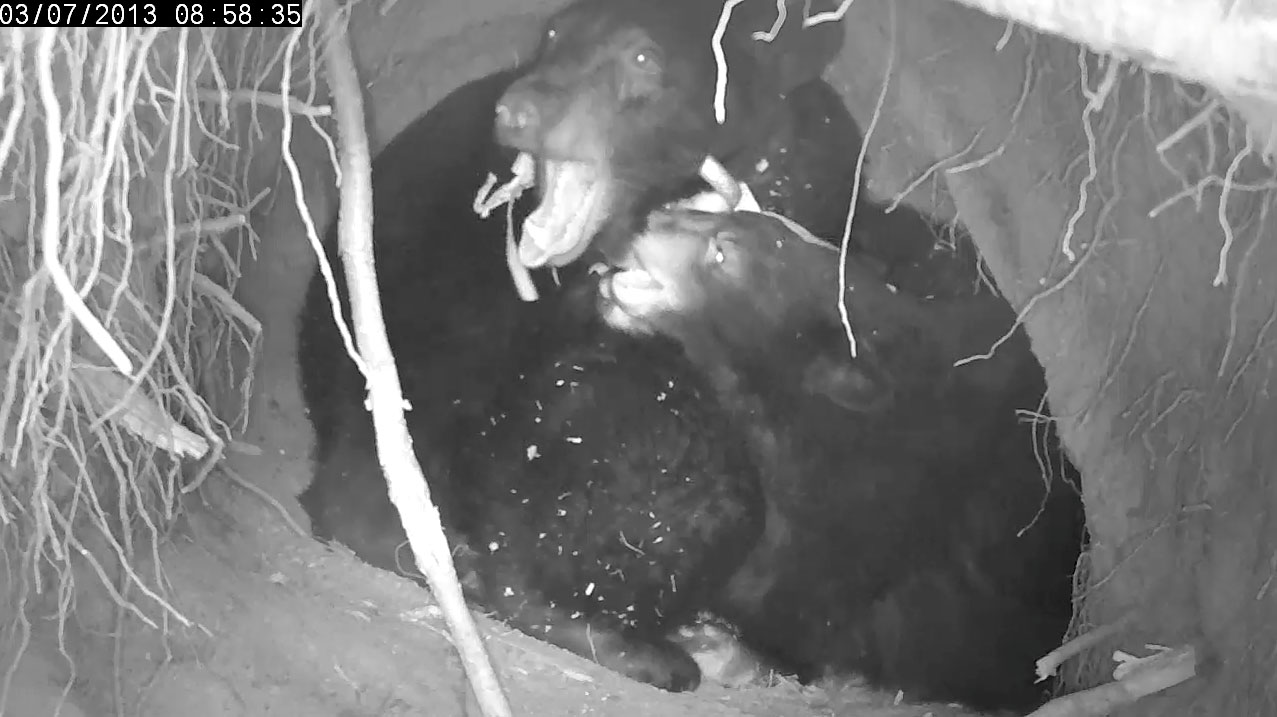 While Jewel yawns, Fern bites her collarSpeaking of sharing information, a Lily Fan asked what we have published since our DNR permit was first issued in 1999. At the risk of making the update overly long, we listed them below. They include 3 peer-reviewed papers on black bears, a peer-reviewed Smithsonian book chapter on the black bear, an invited paper on black bear habituation, a published summary of an invited presentation for a U. S. Fish and Wildlife Service Workshop on diversionary feeding, a master’s thesis entitled “Effects of supplemental feeding on weights and reproductive success of black bears,” and 2 poster papers on diversionary feeding we presented at professional bear conferences. We recently submitted a manuscript for peer review and are collaborating with other authors on another paper for peer-reviewed publication.
A peer-reviewed paper we are anxious to publish because of its importance to the understanding of bear-human relations is the bear-human data from Eagles Nest Community where about a dozen households have been hand-feeding bears since 1961. You can see preliminary information on that in the narrated PowerPoint presentation at Can food lead black bears out of trouble?
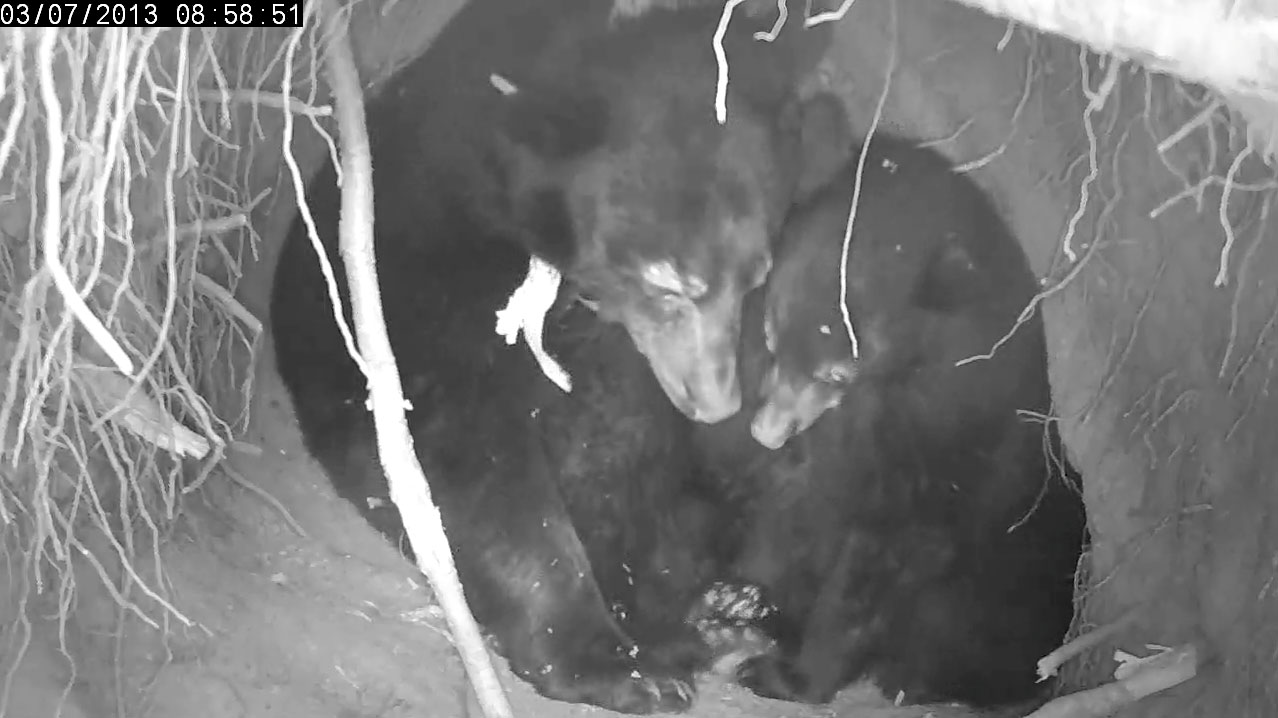 Jewel and FernThe hold-up on publishing a peer-reviewed paper on diversionary feeding in Eagles Nest Community is a DNR prohibition on our citing DNR complaint data that is otherwise available on their website. Feeding is against DNR recommendations. The DNR prohibited us from using the data in 2011 when we were putting together that data set. We’re not advocating feeding, but the topic is worthy of study and peer-reviewed publication. We believe in letting scientific data speak without censure. We know that ideas that differ from accepted thought often meet with resistance. We’re still hoping to see a change of heart regarding our use of the DNR bear complaint data.
Actually, diversionary feeding is not a new idea. Native Siberians have been doing it for generations to coexist with polar bears, and the U. S. Fish and Wildlife Service is considering diversionary feeding to reduce conflict between polar bears and native villages where global warming is making it harder for polar bears to catch seals. Ranchers in Montana have been doing it since 1988 to coexist with grizzly bears. Parks Canada in Alberta has been doing it since 1998 to better coexist with grizzly bears. And diversionary feeding was the only thing that prevented house break-ins around Lake Tahoe in the extremely bad food year of 2007 as can be seen at http://www.youtube.com/watch?v=98iQe_UZ-Fc&list=UU3Ewo-eR1OgOHgCgKpXu17Q&index=5. Ely resorts recognized the diversionary function of garbage dumps long ago.
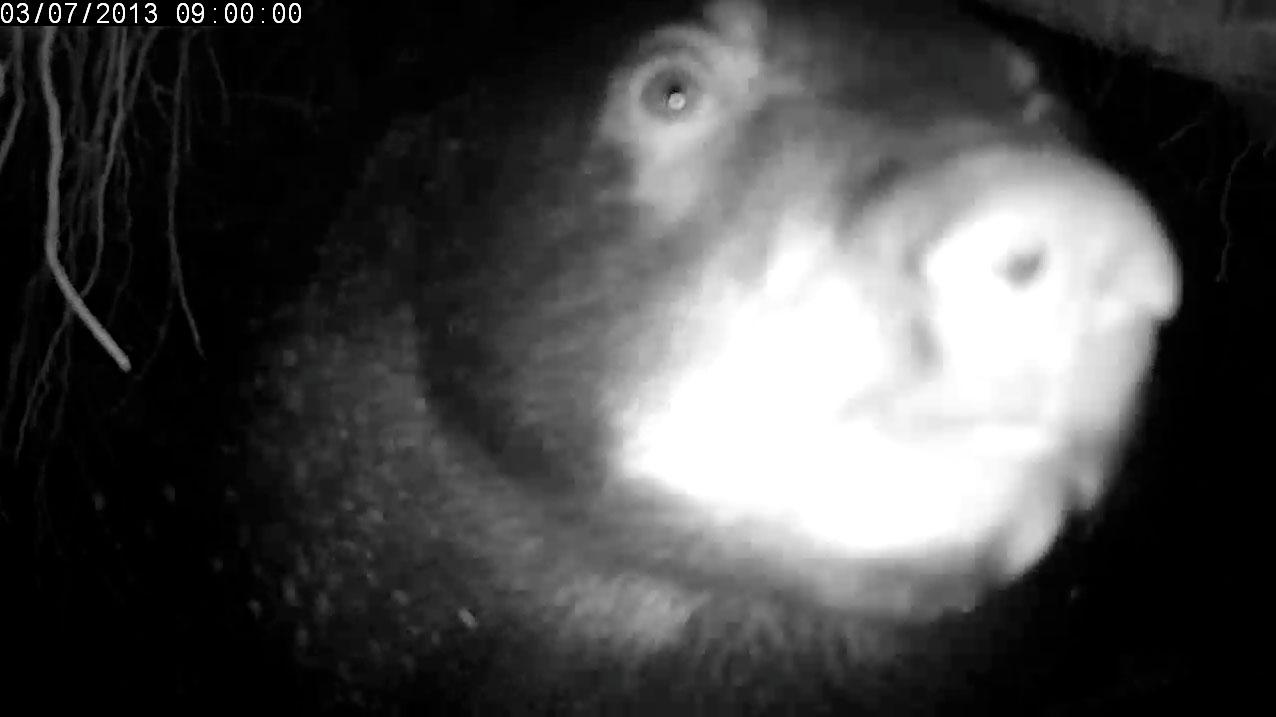 Fern noses the cameraSince we published (in 2011) our peer-reviewed paper on the U. S. Forest Service diversionary feeding study at a campground and residential area, interest in the topic has expanded. A summary article about diversionary feeding of black bears can be seen at http://www.humanesociety.org/news/magazines/2011/09-10/bear_country_part_4_court.html.
Another scientific paper we are anxious to publish is the data from the Den Cams these past several years. We are very glad we didn’t rush to publish these data the first year (2010). Since then, the data have varied so much among the dens and years that premature publication would have skewed perceptions of what goes on in a den. The relative lack of play in Jewel’s den this winter compared to the energetic play we saw between Lily and Hope in 2011 and Lily and Faith 2012 is one example.
Recent publications are:
132. Dykstra, J.A., L. L. Rogers, S. A. Mansfield, and A. Wünschmann. 2012. Fatal disseminated blastomycosis in a free-ranging American black bear (Ursus americanus). (peer-reviewed) Journal of Veterinary Diagnostic Investigation. 24(6) 1125–1128.
131. Rogers, L. L. 2011. Case study: Black bears in Minnesota. [invited talk]. Summary, pp 31-32 In Polar Bear Diversionary Feeding Workshop Report. Karla Dutton, Susanne Miller, and Terry DeBruyn, editors. Anchorage, Alaska. June 8-9, 2011.
130. Rogers, L. L. and S. A. Mansfield. 2011. Can food lead black bears out of trouble? [invited talk]. 20th International Conference on Bear Research & Management, Ottawa, Ontario. July 17-23, 2011.
129. Rogers, L. L. and S. A. Mansfield. 2011. Behavior of supplementally-fed black bears in Eagles Nest Township, Minnesota. [Poster paper]. 20th International Conference on Bear Research & Management, Ottawa, Ontario. July 17-23, 2011.
128. Rogers, L. L. 2011. Does diversionary feeding create nuisance bears and jeopardize public safety? (peer-reviewed) Human-Wildlife Interactions. 5(2): 287-295.
127. Rogers, L. L. and S. Mansfield. 2011. Misconceptions about black bears: a response to Geist (2011). (invited commentary) Human-Wildlife Interactions. 5(2): 173–176.
126. Rogers, L. L. 2010. Does diversionary feeding create nuisance bears and jeopardize public safety? (submitted paper) Pages 72-82 in C. Lackey and T. A. Beausoleil, editors, Western Black Bear Workshop 10:72-82.
125. Rogers, L. L. 2008. Understanding Black Bears. (Popular article) The Leader. 38(8): 4-6.
124. Peters, G., Owen, M. & Rogers, L. 2007. Humming in bears: a peculiar sustained mammalian vocalization. (peer-reviewed) Acta Theriologica 52: 379-389.
123. Mansfield, S. A. 2007. Effects of supplemental food on weights and reproductive success of black bears in northeastern Minnesota. Unpublished master’s thesis. Antioch University New England, Keene, New Hampshire. 49pp. plus Appendix.
122. Fair, J., and L. Rogers. 2006. (Scientifically accurate popular book) Bears for kids, 2nd edition. Wildlife Research Institute. Ely, Minnesota. 48 pages.
121. Rogers, L. L. 2005. Weight-carrying ability and caching behavior of Gray Jays, Perisoreus cacadensis: Adaptations to boreal winter. (peer-reviewed) The Canadian Field-Naturalist 119(1):101-104.
120. Mansfield, S. A., and L. L. Rogers. 2005. Behavior, wild diets, and weight gains of supplementally-fed black bears in northeastern Minnesota. [Poster paper]. 15th Eastern Black Bear Workshop, Tallahassee, FL. Apr 2005.
119. Rogers, L. L. 2000. Bear family group. (scientifically accurate popular article) Fish & Game Finder, vol 23, no. 7, November 2000, pages 9-13.
118. Rogers, L. L. 1999. Black bear. (Peer- reviewed by Don E. Wilson, Director of Biodiversity Programs at the Smithsonian’s National Museum of Natural History) Pages 157-160 in Don E. Wilson and Sue Ruff, eds. The Smithsonian Book of North American Mammals. Smithsonian Institution Press. Washington, D.C.
117. Rogers, L. L. 1999. Bear center conducts hibernation study. (Scientifically accurate popular article) North American Bear Center Newsletter 3(4):1-3.
116. Rogers, L. L. 1999. The summer of the bear attacks: What's behind the Wisconsin bears in the news? (Scientifically accurate popular article) Northland Reader 3(57), September 16, 1999: 14.
115. Rogers, Lynn. 1999. Black bear fun facts. (Scientifically accurate popular article) Lake Country Journal 3(4)July/August 1999:cover, 8-9.
114. Rogers, L. L. 1999. Spring and the mating season. (Scientifically accurate popular article) North American Bear Center Newsletter 3(2), Spring, 1999:1-2.
A video of Lily and cubs from yesterday is available at http://www.youtube.com/watch?v=H-NdmQv5jys.
Thank you for all you do.
—Lynn Rogers and Sue Mansfield, Biologists, Wildlife Research Institute and North American Bear Center
All photos were taken today unless otherwise noted.