
 Pete - Sept 24, 2005 We nearly completed the DNR Report today.
Bear Curator Donna Andrews and the new Operations Manager Judy Thon are looking forward to the annual Hinckley Gathering of Lily Fans next Saturday, November 3, from noon to 6 PM. Sarah Zirbes is making it happen and is the person to contact about coming ($20). Contact Sarah through Facebook at http://www.facebook.com/events/251476134972132/ or write to
On the Hope Learning Center construction, there was a change in plans. This coming Wednesday, October 31, Kraus-Anderson Construction Company will remove the stairs that go to the viewing balcony and realign the bear enclosure fence. Digging the new foundation will start November 5. The precast concrete walls will arrive December 17.
We pulled archive footage from 2007 to create the video of June and her cub Lily, Cal, and Bud posted at http://www.youtube.com/watch?v=ysZg855ORZA. We have also posted another Walk With June from 2005. It is rather long, but hopefully a good read.
Thank you for all you do.
—Lynn Rogers and Sue Mansfield, Biologists, Wildlife Research Institute and North American Bear Center
Bear: June
There was no Tuesday walk with June last week because there was no June to walk with. She fed at feeding station M about 7:00 PM Sunday the 18th but by the next afternoon her signal had disappeared from the study area. I searched deeper and deeper into her territory then climbed the Jasper Peak fire tower – still no signal. She had been staying within a mile of homes where she feeds for six weeks when suddenly she vanished. I could only think she had been killed by a hunter and I was devastated.
To ease my grief I switched my energies to her cubs – preparing radio collars for them and containers of sweetened condensed milk to occupy them while we collared them. I wanted to salvage as much as I could from this tragedy. We alerted neighbors to be on the lookout for orphaned cubs and waited not-so-patiently for the cubs to show up. Someone suggested they might be hanging out near the gut pile or drag trail so I hiked miles of ATV trails looking for any sign. As the days wore on and the cubs did not turn up my grief became profound. Losing June was very painful – but losing the cubs as well was almost more than I could bear.
On September 4th 8-year-old Blackheart’s signal had disappeared within a 2-hour time period and circumstantial evidence suggested she had been killed by a hunter and the collar either destroyed or taken out of receiver range. Nothing concrete had been found but a bait site was located close to where she had been for the 3 days prior to her disappearance and several gunshots had been heard the day her signal vanished. I flew the area in a float plane searching in vain her signal. I remember thinking at the time “If it can happen to Blackheart it can happen to June”.
I spoke with Karen Noyce at the MN DNR. The DNR actively discourages hunters from killing collared bears yet the DNR had already lost 8 of their 40 collared bears to hunters this year (9 before the season was over). Karen generously offered to have Pam Coy scan for both June’s and Blackheart’s frequencies when Pam flew Thursday Sept 22nd to check on the DNR bears.
 Tired June - Sept 24, 2005As I located bears Thursday afternoon I found June’s sister Hazel in an easily accessible area. I decided to try to connect with her. Although she has never come to me in the woods, her 3 cubs are very mellow and trusting so I decided to give it a try. With June gone I wanted to try to habituate another bear to being walked with. I had hiked in close to Hazel and was patiently talking to her hoping she would let me at least see her. My attempt was interrupted by a call from Pam Coy. She had located June’s frequency in a roadless area of the Boundary Waters and had sent me the coordinates in an email. I had a frustratingly lousy cell phone connection but I was able to piece together enough to know there was hope! I rushed back to the field station to download my email – calling ahead so Lynn could dig out some maps.
Traveling so far was not like the June I knew, so we dared not get our hopes up. It was possible there was a collared moose, deer or wolf with the same frequency.
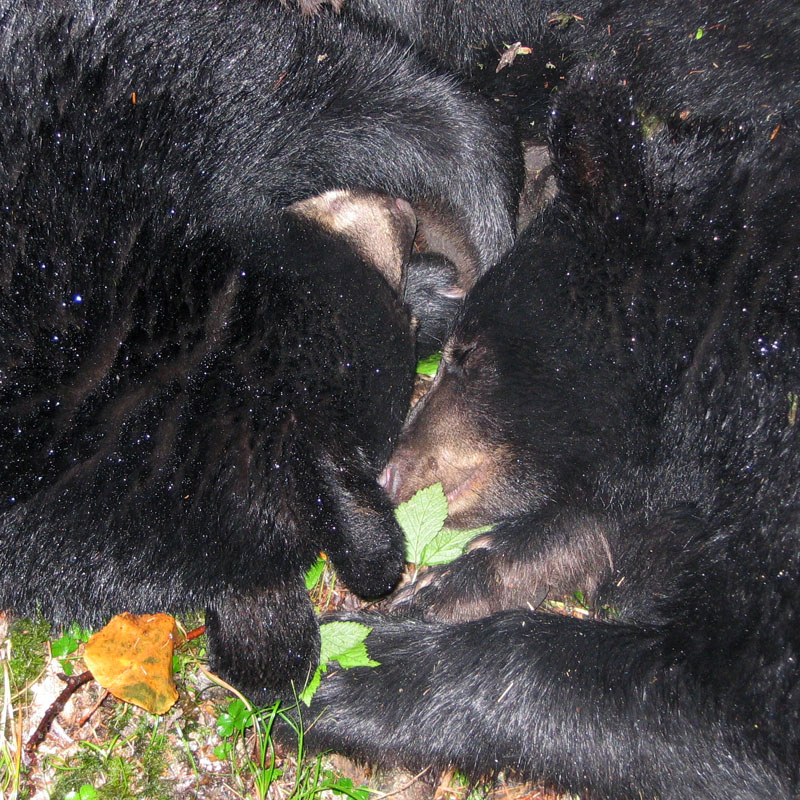 Tired cubs - Sept 24, 2005Lynn made a few calls and found there were no other research animals with that frequency, so we knew this was likely our June bear. We plotted the coordinates on a map and found her to be 15 miles NNE of the field station. Lynn remembered an email he had gotten from Donna Phelan saying to check which way the wind was blowing the day June disappeared. We did a quick check of the Weather Underground history and found the wind was coming out of the NNE that day – and that day only! We are left to suspect June had been drawn in that direction by a scent she picked up on the wind.
 June nursing cubs - Sept 24, 2005As we discussed how to get in to check on her, I realized we were running out of daylight. As much as I needed to see her, I would have to wait. Friday morning I set out to see if I could get a fix on her and also check the oaks in that area for acorns. I headed up the Echo Trail – beautiful country! I stopped at a couple high points but got no signal. I climbed up to a ridge to check the oaks and found a good crop of acorns. I headed further out the Echo Trail in case June had ventured further north but still got no signal. I then worked my way back – assuming she would travel in more or less a straight line if she was headed back. From the south side of Burntside Lake I was able to locate her on the north side of the lake near School Section Bay – still in a roadless area. I was delighted to hear her signal again! Her signal was very active and I felt she was headed back. Later that day I tried locating her again to monitor her progress – but misjudged the route she would take and failed to pick up her signal.
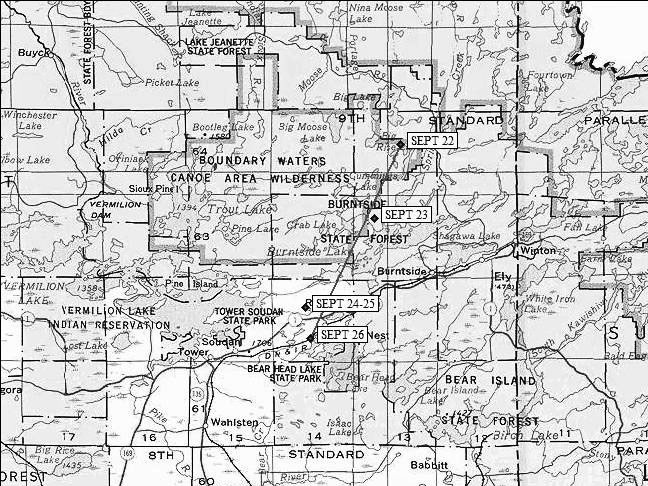 Map of June's travels - Sept 2005Saturday morning as I was locating the other study bears I picked up June’s signal faint to the north. After pinpointing her location I located the other research bears then checked on her again. June hadn’t moved so I decided to walk in on her. It was cold and raining but I had to see her to ensure she was okay. I found June resting in a cedar swamp at the boundary between RC’s and Braveheart’s territories and about 2 miles north of her own territory. She and her cubs looked fine but appeared tired. After feeding on the nuts and seeds I brought, they returned to their bed and licked rainwater off each other’s fur. Soon June fell into a deep sleep and began snoring. Both cubs snuggled close to her and periodically curled into a position used during hibernation – curled up on their stomach with their head tucked in under them. I scanned the area for scats hoping to find something to confirm the theory that acorns had drawn them so far away. Finding no scats, I waited in hopes one would be ‘produced’. After several hours, I chose to GPS the location and return the next day to check for scats.
The following day I found June and her cubs in the very same bed. There were 3 scats nearby – all containing the seeds I brought them the day before. I spent several hours with them as they slept, wandered to another bed site and slept some more. I chose to leave them in order to locate the other research bears and planned to check June’s location again later. By 9:57 PM that night June was back in her territory – nearly a week after she had disappeared.
Today I did my regular Tuesday walk with June and her cubs. They spent the day bedded in one spot – either sleeping or resting. Not an exciting 'walk' by any means. They are definitely slowing down (June's resting heart rate is between 40 and 48) and should be denning soon. My stay here has been extended 2 weeks so hopefully she will den before I have to leave.
As I was reclining against a leaning cedar on this nearly cloudless 70 degree day with June and her cubs sleeping nearby, I felt at peace. The anguish I felt at her loss is but a memory. The experience of thinking she had been killed made me realize how very special she is and how difficult it would be to start over with another bear. We are learning things by walking with June that can't be learned any other way. More needs to be done to protect these valuable research bears.
Addendum: A scat collected at her bedsite on Sept 25 contained pieces of acorn shell – circumstantial evidence that they had left the study area in search of acorns.