
 Wounded bear rests - Oct 7, 2012 Today was a catch-up day in the office. We did not get out to check on bears. We did, however, keep tabs on Jewel. She is the only bear still roaming that has a GPS unit. Over the past week we have ‘seen’ her check out a couple of known dens and even return to one several days later. While 9-year-old Juliet and her cubs have been at a den since Sept 22, Jewel and her cubs have remained active. One possible explanation is that, as a 3-year-old, Jewel is still growing herself and therefore would benefit from any extra food she can find.
Bev Hauptli created a “Smilebox” to express her appreciation to all the volunteers who made the Groundbreaking happen. In recognition of the Hope Learning Center, she included many pictures of Hope as well as of the Groundbreaking. It can be seen at http://smilebox.com/play/4d7a4d304e544d774f44413d0d0a&;blogview=true&campaign=blog_playback_link. An article about the Groundbreaking and the new addition appeared in today’s Mesabi Daily News at http://www.virginiamn.com/news/article_090192b0-102d-11e2-827a-0019bb2963f4.html.
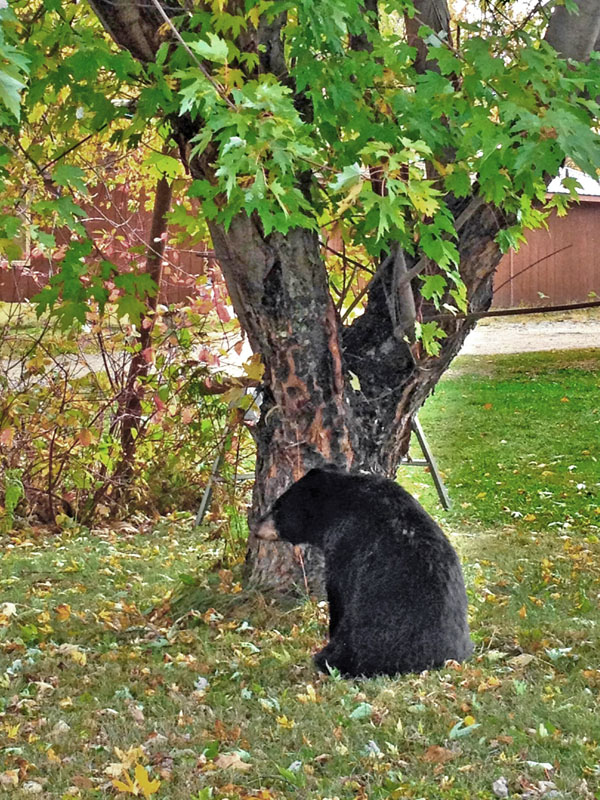
 Wounded bear limps - Oct 7, 2012We got two calls today about a wounded bear limping to an apple tree to eat in a ‘suburb’ of Ely. We started driving; hoping to see the bear, get some idea of the extent of its wounds, and talk to the concerned folks who had called—but we then got a call the bear had disappeared. Bears have made remarkable recoveries during hibernation. Hopefully this bear will heal well. These pictures were sent to us by one of the concerned residents.
Fellow birders asked if there is a list of birds and other wildlife seen here on the Wildlife Research Institute property like we mentioned recently. Here’s the link http://www.bearstudy.org/website/images/stories/Documents/wri_wildlife_seen.pdf.
We’ve always felt fortunate for our lack of deer ticks here. Those are the ticks that spread Lyme disease. We’ve never seen one, even when we put road-killed bears on sheets of plastic to identify the hundreds of ticks that crawl off the cooling carcasses. All were dog ticks (Dermacentor variabilis). No deer ticks. Although they are called deer ticks, they mostly live on small mammals. A recent article in the Proceedings of the National Academy of Sciences at http://www.pnas.org/content/early/2012/06/12/1204536109.abstract helps explain the rarity of deer ticks and Lyme disease around here. It’s wolf country. Wolves suppress coyotes, which in turns helps foxes survive to prey on small mammals. The article tells more.
Thank you for all you do.
—Lynn Rogers and Sue Mansfield, Biologists, Wildlife Research Institute and North American Bear Center