
 June - Aug 13, 2012June’s GPS readings show her foraging in a wetland where we have accompanied her in the past as she ate wild calla (Calla palustris) leaves. Why these are a favorite, we’ll never know. They contain oxalic acid crystals that would certainly deter people. Wild calla seems to be a staple in the diet of bears in this area—sometimes their first meal in the spring and their last meal in the fall.
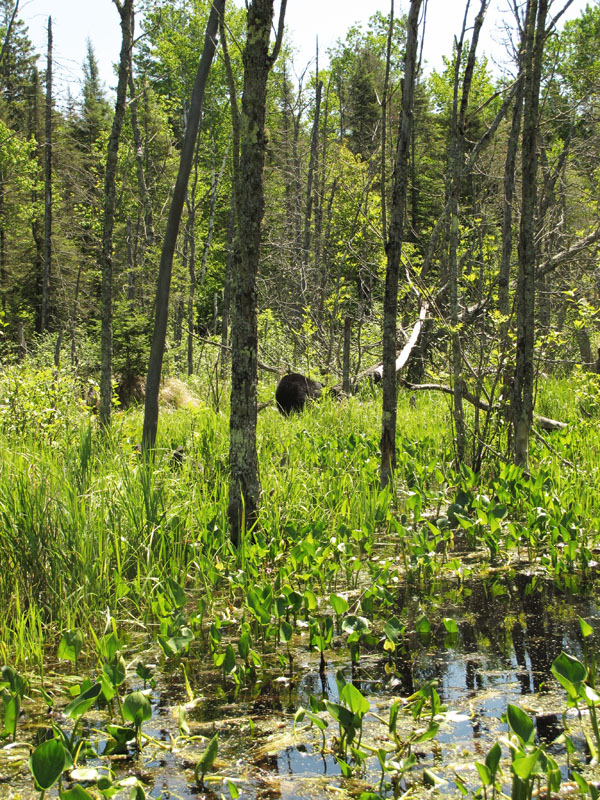 June feeding on wild calla on May 31. She spent at least 25 mins here today.Baiting has begun for the bear hunt which starts September 1, and a bear guide is baiting heavily near the Research Center. He is requiring that his hunters not shoot radio-collared bears or mothers with cubs. Lynn had a good talk with him today, and the guide said he would call Lynn to come and photograph the bears his hunters kill so we know which ones have been taken from the population we're studying.
His operation will bring more hunters than usual to this area but his cooperation with research in this way will leave us with fewer questions. In the past, we haven’t known which bears were killed and we were left to wonder when a bear didn’t show up the next spring. We were usually pleasantly surprised that nearly all made it through the hunting season. However, with the scarce food this year, more bears than usual will be drawn to hunters’ baits. We appreciate this guide’s cooperation. He said he will work with us and spare radio-collared bears if he is not hassled. He said if he is hassled, the deal is off. We will cooperate every way we can to spare the radio-collared bears and learn which of the others are killed.
We radio-collared yearling Daisy this morning. Hot pink BioPlastic strips were attached to her collar to make it more visible to hunters. She is the first of our study bears to get ‘bedecked.’ We’ll work to clearly mark the collars of all the study bears this coming week.
Thank you for all you do.
—Lynn Rogers and Sue Mansfield, Biologists, Wildlife Research Institute and North American Bear Center