
 NABC bear enclosure from the back - July 25, 2012We ended the Black Bear Field Course with a behind-the-scenes visit to the home of Ted, Lucky, and Honey. The photo is from the back of the bear enclosure across the valley toward the Bear Center. The light edge of the roof is barely visible in the background. This forest is where the bears do their natural foraging in addition to eating foods provided by the staff. This is one of the spots where the behind-the-scenes photo shoots take place, sometimes catching the bears eating raspberries, cherries, wild sarsaparilla berries, ant pupae, and a variety of greens.
How do Ted, Lucky, and Honey know what wild foods to eat when they had spent no time in the forest before coming to the Bear Center? Somehow, they knew what was good and immediately began eating the same foods wild bears eat. Foraging for natural wild foods in the forest is one of the highest orders of enrichment that could be provided for captive bears—along with having fellow bears to provide the kinds of interactions we and the pond viewers see among Ted, Honey, and Lucky. We at the Bear Center feel blessed to have the natural forest space to make possible an enclosure that is a model for captive bear enclosures worldwide.
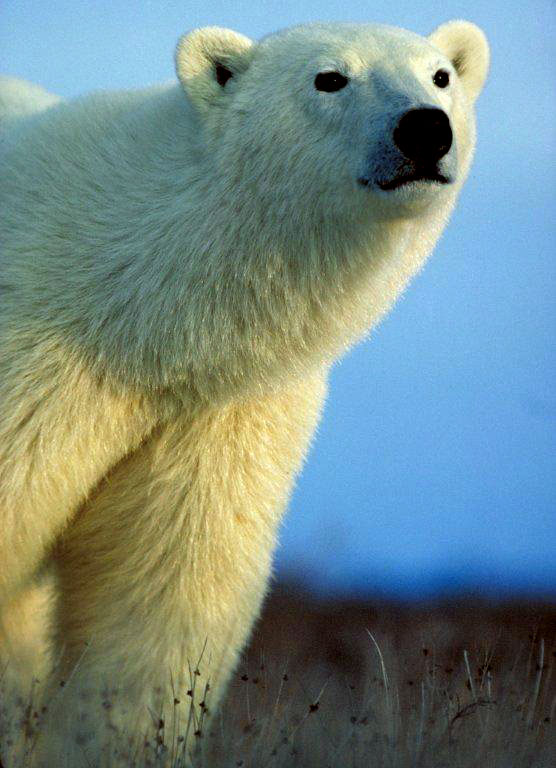 Polar bear near ChurchillInside the Bear Center, we constantly update exhibits as new information becomes available. We now need to update the evolutionary information on polar bears. The latest scientific information on when polar bears diverged from brown bears came out the day before yesterday in the Proceedings of the National Academy of Sciences, pushing back the split to 5 million years ago http://www.nytimes.com/2012/07/24/science/brown-bears-and-polar-bears-split-up-but-continued-coupling.html?_r=1. For many years, scientists estimated the split to have been only a couple hundred thousand years ago. It was only a rough estimate because polar bears often die at sea and sink to the bottom where their bones are lost to science.
Solid data could not be obtained until DNA testing of live animals became available. DNA testing is getting better and better. In 2010, preliminary studies of mitochondrial DNA studies suggested that the split was more recent—only 130,000 years ago. In April 2012, a new study using nuclear DNA pushed the date back to 600,000 years ago. The most recent study, reported in July 2012, is a more in-depth study using full genomes, and it pushed the date back to 5 million years ago. Part of the confusion may have been due to interbreeding. Scientists believe that during warm millennia polar bears must spend more time ashore and brown bears move closer to the shore, leading to interbreeding.
Thank you for all you do.
—Lynn Rogers and Sue Mansfield, Biologists, Wildlife Research Institute and North American Bear Center