
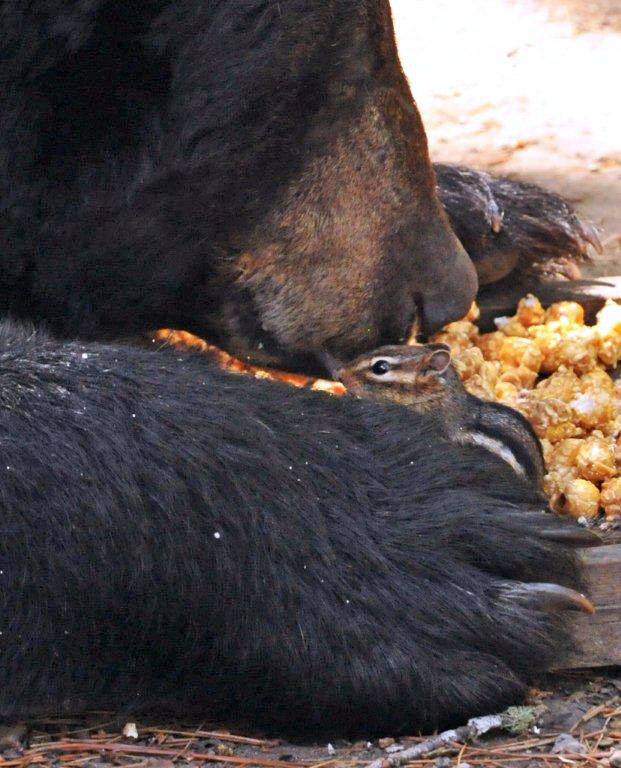
 One-eyed Jack and chipmunk - June 28, 2012At 9:10 AM, we got a call that a bear was lying on a paved road after being hit by a car. As the people drove closer, the bear moved slowly off the road with a “messed up” hind leg. We found the slight bloody area on the road and tracked the bear several hundred yards into the woods. We had hoped to identify and possibly help the injured bear but lost the trail in a cedar swamp.
Injured bears often head for cool, dense forest areas like mossy cedar swamps and alder swamps. We don’t fear attacks by wounded bears. The likelihood of such attacks is played up by the media, but our experience has been the opposite. A possible exception is a reported “attack” by a black bear in Minnesota a couple weeks into the hunting season a few years back. A woodcock researcher was walking through dense lowland habitat homing in on woodcock telemetry signals and suddenly found himself being knocked down by a bear that then departed. We suspect that he nearly stepped on a wounded bear that had difficulty getting up and slipping away as most bears would do in that situation.
Today’s site for the wounded bear is in Dot’s territory. Dot may have lost one of her offspring. The bear was described as “not a big bear” so could have been one of Dot’s 2-year-olds, Kallie (female) or Bailey (male). We’ll be monitoring reports of bear sightings to see if this injured bear is seen again.
Next, we got a call that One-eyed Jack had stepped on a scale and weighed 373 pounds at a feeding site in Dot’s territory. Jack was there trying to regain some of the weight he’d lost over winter and during the mating season. He weighed over 600 pounds last fall.
The rest of the day was preparing a presentation for an informational meeting we will be doing on Saturday.
Thank you for all you do.
—Lynn Rogers and Sue Mansfield, Biologists, Wildlife Research Institute and North American Bear Center