
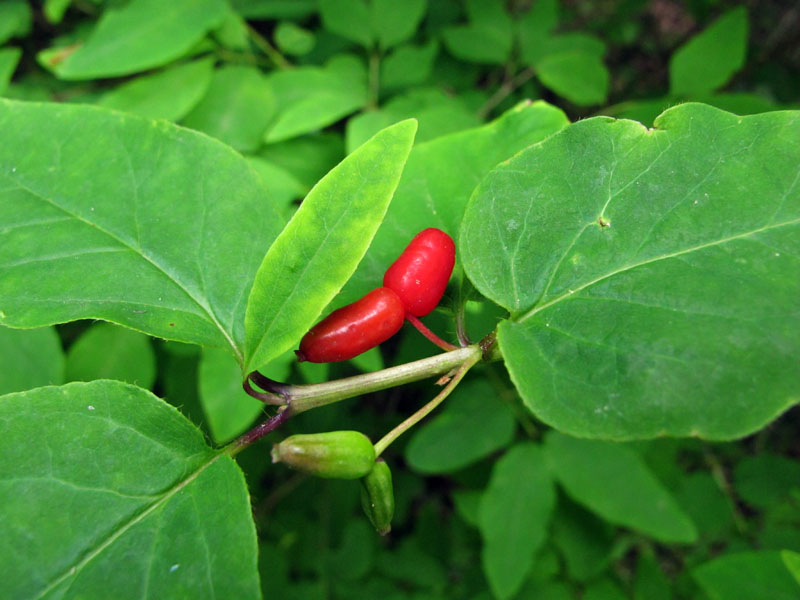
 American fly honeysuckle (Lonicera canadensis) - June 13, 2012It felt good yesterday to locate 2 ‘lost’ bears—June and Sharon—and swap their GPS units to get them ‘back on the map’ again. But the good feeling didn’t last. Sometimes it takes hours for the units to orientate themselves and begin transmitting. But, it doesn’t ever take this long. We’ve received NO locations from either bear. Very disappointing.
And then today brought wind and heavy rain—not a fun day for man or beast to be out and about. Bears are extra skittish and hard to approach on days like today. Telemetry receivers don’t like to get wet (learned that one the hard way) and the woods become dangerously slippery. Good reasons to hunker down and play catch-up on the never-ending office work. Tomorrow promises to be better.
One bear did venture out on this rainy day. Braveheart visited the ‘Magic Scale’ at the field station. Not only does the program record the weight and image of the bear, it also announces there is a bear on the scale by playing a bear vocalization—a friendly bear grunt. So the scale alerted us to Braveheart’s presence and I took the opportunity to swap out her GPS unit. It was a bit of a challenge as she was keyed up by the wind and rain—looking around for danger—but, with a good bit of patience and a few pecans, the deed was done. And Braveheart’s new GPS actually started transmitting locations. Phew!
I have included another June walk below. During this walk, June remodeled a den. It proved to be the den she used the next winter—and the den she had her first set of cubs in. A video of the den dig is posted at http://www.bear.org/website/bear-pages/black-bear/hibernation/20-digging-a-den.html.
Thank you for all you do!
—Sue Mansfield, Biologist, Wildlife Research Institute and North American Bear Center
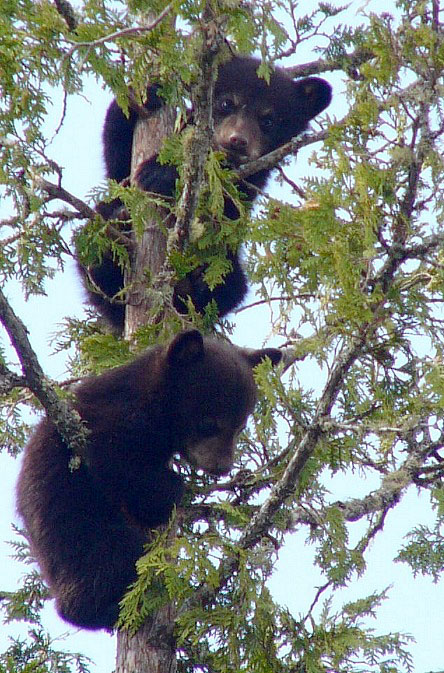 June's first litter (Pete and George) - April 21, 2005Date: July 19, 2004
Duration: 0935 – 1817 hrs
Bear: June
Observer: S. Mansfield
I located June at 9:35 AM just north of the RR grade west of Trygg Road – in the same clump of balsam saplings where we had met for our very first walk – and the exact location where I had pepper-sprayed her! She did not come to me or even get up when I arrived. I merely talked to her as I sat down on a log about five feet away. About 20 minutes later she got up and moved deeper into the balsams and she continued to rest/sleep until 11:45 AM.
Of note during this time:
- A jet flew over and she looked in its direction for a long time. When a second jet flew over later she moved an ear but did not raise her head.
- A logging operation began a half mile or so northwest of this site. This initially elicited much attention – but as the noise continued she seemed to ignore it.
- Though she appeared to be sleeping soundly at times her breathing was shallow and rapid much of the time (63/min) but did slow way down (32/min, 33/min, 30/min) for a short time.
She woke, stretched and defecated at 11:45 AM at which time I fed her a few nuts and a scat marker. She was active until 2:11 PM when she bedded down again. She spent much of this time investigating throw mounds in cedar swamps, possibly assessing den potential. She also climbed several trees and broke branches. She did a lot of bounding off and then slowing down – with me scurrying to catch up. She foraged on wild calla, ant pupae, gooseberry, and dewberry along the way.
Of note during this time:
- June certainly is attracted to plastic bags! I think she expects they all contain something for her. We had issues to work out each time I collected a scat. I also was trying to collect samples of berries she was feeding on for positive plant and seed identification. She tended to half-heartedly cuff (or attempt to cuff) my foot during these huffy times.
- As we were initially walking the RR grade she suddenly looked behind us. I looked too and saw a person coming. I looked back at June and she was running away. I quickly looked back at the person and saw the person running in the opposite direction. I am sure this person had seen me too and may have just not wanted to interfere with the study. I was able to catch up to June easily as she was sitting just into the woods on the other side of the RR grade.
- A passing vehicle on the RR grade got her full attention – even though we were quite a ways into the woods at that point.
- In one area she slowed way down and was sniffing branches intently. She spent considerable time sniffing a rather large bed that I believe may have been a moose bed. She was walking through this area in slow motion – practically tip-toeing.
- She straddled a couple of trees in this area. She did not seem nervous – just very alert and intent. I followed as quietly as I could.
- Just before we left the area where she was so quiet and intent, she nipped off the end of an interrupted fern and ate it.
While she was resting between 2:11 PM and 3:45 PM it rained for about 20 minutes – enough to leave the woods dripping for hours. Cameras where stashed for much of the rest of the walk because of the wetness. I found that even ‘Rite in the Rain’ paper gets soggy!
June did much more foraging during this next active period. She fed mainly on ant pupae – seldom passing a stump without sniffing it. Feeding was brief and intense whenever ant pupae were found. She also fed extensively on dewberry. Often she was just grabbing a berry here or there as she moved from stump to stump but she did feed extensively in at least a couple areas. Other food items included: sarsaparilla (still not dead ripe), American fly honeysuckle, and unripe dogwood (likely red osier).
Of note during this time:
- June led me to a dug den. From the way the large-leafed aster was growing up around the dirt mound it may have been dug prior to this growing season. Because June went right into the den and began working I was not able to assess whether it had been used this past winter. She worked feverishly for about 20 minutes on enlarging the den – at one point pulling out a huge rock and gasping for breath afterwards. She then went off and defecated before returning to work on the den. I was able to catch much of this den work on video. Several times she backed into me as she was pulling dirt away from the opening.
A total of 8 scats were collected during this walk. Although 5 ½ hours passed after feeding her the first scat marker the marker did not appear in any of the scats collected.
Addendum: June gave birth to her first litter (2 males) in this den the following winter.