
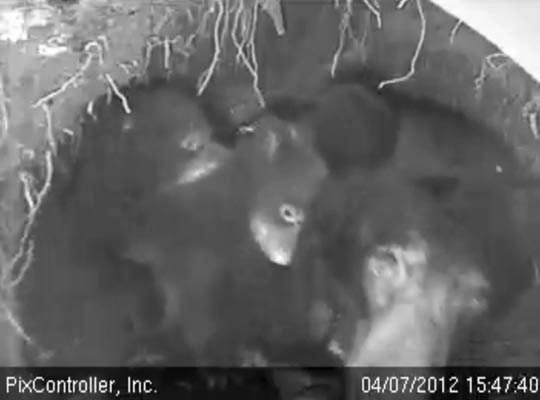
 Jewel gets mugged by her cubs - April 7, 2012Mothers with yearlings are keeping to remote areas instead of seeking food around houses. Food is scarce in the woods, and all the radio-collared bears know where they can get unlimited high quality nuts from a dozen feeding stations in the study area. Why are they not taking advantage of that knowledge? Sometimes what might make human sense does not make bear sense.
Without actual data on what the bears are doing, common sense would say that bears should come out of their dens hungry after 6 months without food and would head for the nearest sure meal. They should be trying to regain lost weight by devouring the most calories with the least effort. They should be aggressive and bold in their efforts to end their starvation diets—and all the usual statements one hears about hungry bears in spring.
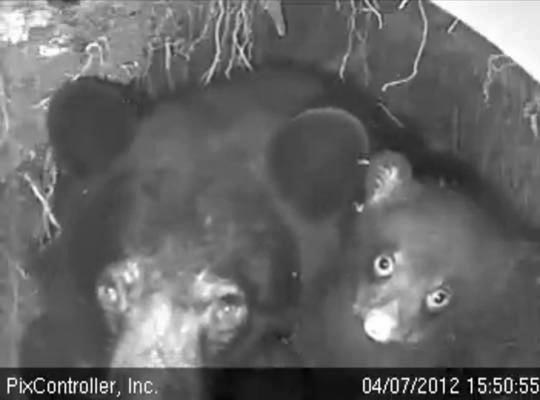 Jewel and Herbie - April 7, 2012But bears come out of their dens with shrunken stomachs and reduced metabolisms. They’re in a state of “walking hibernation” as they transition to full metabolism and full hunger. They still retain denning characteristics like Lily sleeping in the hibernation position and Jewel shaking as she wakes up and pumps blood into her arms and legs. Bears with reduced metabolisms become shy and risk averse. They try even more than usual to avoid danger. We see that in the fall as they slow down, and we see that in the spring as they go through the spring transition. What the radio-collared bears are showing us is how it is. Lily Fans are learning along with us from the bears themselves.
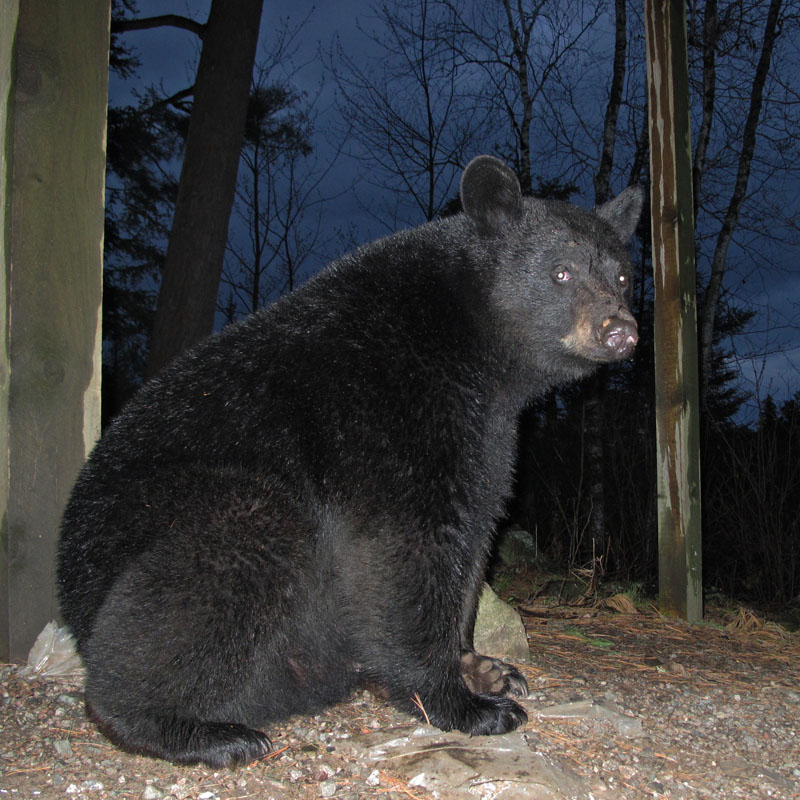 Jim - April 7, 2012Last night, we had our first bear visit of the year—Jim, a 2-year-old we know well. Bear behavior varies among individuals, of course. Jim is advanced enough in his recovery from hibernation to make the first visit. But even he is still unusually timid. He saw us and ran. He is not radio-collared.
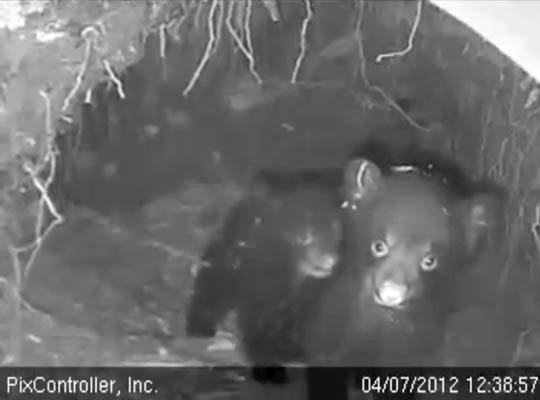 Fern and Herbie - April 7, 2012So far, none of the radio-collared bears are at the point where they want to visit feeding stations in populated areas where they may have to contend with other bears. Even though spring came early and bears emerged early, they are playing it safe and eating meager greens that are just starting to grow. They are subsisting on willow catkins, wild calla shoots, tiny snow fleas, and grubs that require a lot of work per gram of fat and protein.
Mothers with newborn cubs are held in place, of course, by their cubs’ lack of mobility. Jewel is staying very near her den. Juliet, who was flooded out of her den, is remaining near the bed she made and is using just as small an area as Jewel is. Dot explored up to 0.2 mile away yesterday but is still tied to her den and cubs.
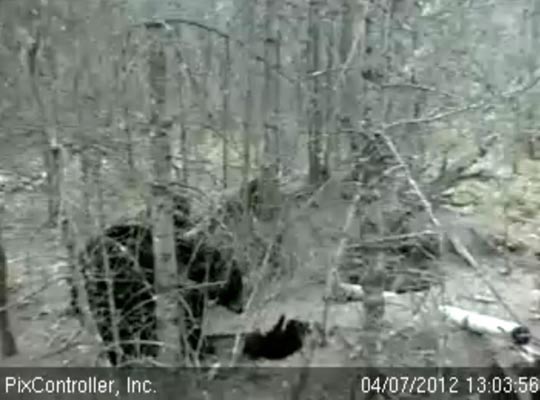 Jewel and cubs outside den - April 7, 2012We’ll see how long this pattern lasts. It’s still early. We’ll see how the onset of roaming, full metabolism, and visits to feeding stations compares with other years. We’ll be looking to get heart rates from any bears that will let us do that.
 Cub sniffs the camera - April 7, 2012More on the much appreciated volunteer efforts by so many. You might remember the “Bear Tales” book that includes at least 102 Lily Fans as authors. Yesterday, the volunteer team that has been editing and shepherding the book to publication sent the manuscript to a publishing company at the request of the company’s owner. The owner will give us honest advice on whether it would be in the best interest of the Bear Center to let the publishing company invest in the publish costs and publish the book, letting us buy books at half price to sell through the Bear Center gift shop and web store; or whether it would be best for the Bear Center to publish it and partner with the publishing company for distribution to stores in addition to selling it through the Bear Center and Web Store.
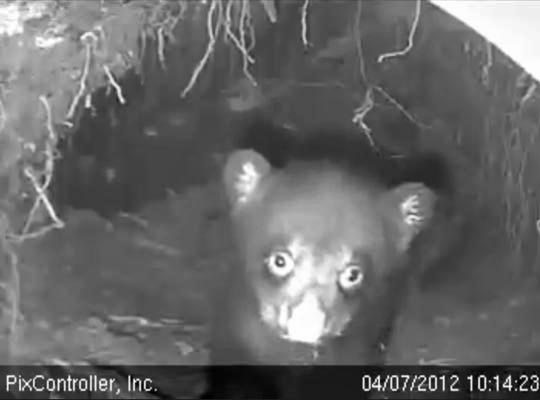 Herbie - April 7, 2012Many thanks for all the work so far from the 102 authors, the editor, and the others making this happen. The nice thing about this book is that the stories describe the usual everyday encounters people have with bears. All the stories are short and will make good bedtime stories. The book will be a nice addition to the Black Bear Boxes being circulated to schools and libraries. In a new pilot project, people are lining up to be docents taking the boxes around to schools.
As we write this, a day of eagle after eagle flying north overhead is ending with the relentless calling of a saw-whet owl and spring peepers and the splashing of hooded mergansers and mallards in the lake.
Thank you for all you do.
—Lynn Rogers and Sue Mansfield, Biologists, Wildlife Research Institute and North American Bear Center