
 Jewel finds her old collar - March 28, 2012One of the videos tonight shows a cub initiating mutual tongue-licking with Jewel, as we have been seeing the last couple days. As we’ve said before, we don’t know why they do it.
The update from March 19, 2010, says “And what is the purpose of tongue-licking? Is it to transfer microorganisms helpful in digestion before they get out in the big world eating more than milk? Is it for bonding as evidenced by adult bears occasionally doing the same? Extending the tongue is a friendly greeting as can be seen in the video Ted and Lucky 'Making Friends' on www.bear.org (http://www.bear.org/website/the-nabc/meet-our-bears/luckys-page/98-how-do-bears-make-friends.html)."
 Jewel chews the collar - March 28, 2012As we recall, there was less of this when Faith and Jason were cubs. They did some of it with both Lily and Hope. Does it cement a bond? There certainly was a bond between Hope and Faith. Again, a larger sample size is needed to avoid jumping to conclusions.
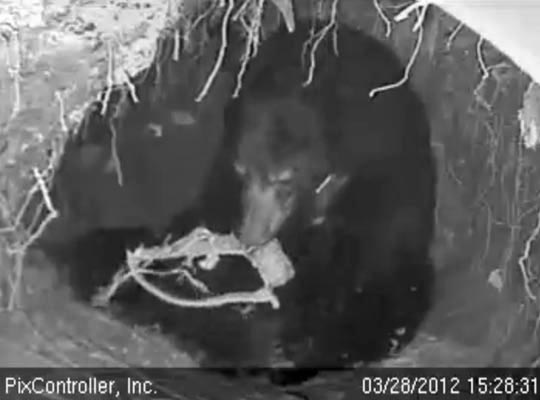 Another collar destined for refurbishing! - March 28, 2012Is the mutual tongue-licking we see between mothers and cubs related to the tongue-extending greeting we see between bears or between bears and humans? At the Bear Center, Ted often extends his tongue and licks humans, but he is never so responsive as when the human reciprocates. It would be interesting to see if Ted would remember if one of the humans who reciprocated came back.
There was so much activity in Jewel’s den yesterday that we have 2 highlight videos to share with you. Part 2 contains the tongue-licking sequence.
Part 1: http://www.youtube.com/watch?v=jdVqbx4qzUM
Part 2: http://www.youtube.com/watch?v=YVpRoEPEX5s
More on the research.
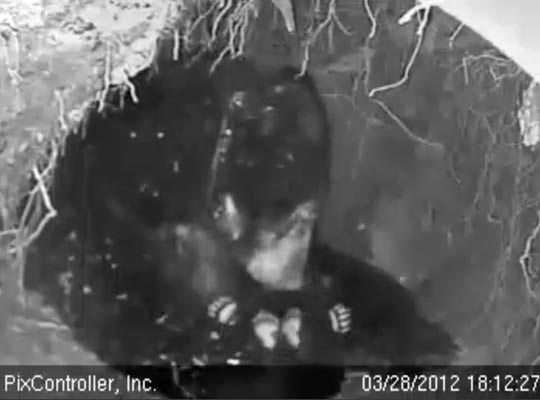 Jewel and cub feet - March 28, 2012After decades of studying bears under various circumstances, we saw the need for a lot more research regarding the bear-human interface, including feeding bears. We did a study of diversionary feeding to alleviate bear problems at a U. S. Forest Service campground and nearby residential area back in the 1980’s and reduced problems 88%. Follow-up was needed. We know the power of food to lure bears into trouble, but that study showed that it was just as powerful in leading bears out of trouble. We began studying bears in the current area where people had fed them since 1961. A check of DNR bear complaints during 1996 to 2005 found them to be 80% lower than the statewide average on a per bear basis.
 Jewel and cubs - March 28, 2012We wanted to know more about how the residential feeding affected bear behavior, diet, reproduction, and relations with people. Modern technology and our trust-based methods produced more insights than ever were possible before, and we saw misconception after misconception fall by the wayside. We saw bears that could have been lazily eating at feeding stations working hard miles away to obtain the same variety of wild foods we had documented bears eating in previous studies. We saw bears go days, months, and years between visits to feeding stations. We accompanied them and learned more and more about black bear life, as we all are learning by watching them on the Den Cams.
 Jewel's cub plans an escape - March 28, 2012Research topics are grouped into 11 categories:
- Black bear-human relationships
- Travels, land tenure, and social organization
- Communication
- Effects of food on weight, reproduction, and survival
- Hibernation
- Care and development of cubs
- Play
- Morphology, physiology, and abilities
- Parasites
- Bear sign
- Habitat and other environmental factors
We’ll come back to research topics in future updates.
We had a nice visit with Peter Braat from South Africa's WildEarth today. He's visting the U. S. on business and made a special trip to Ely to see us. WildEarth has broadcast our Den Cams for 3 years now, and it was great to meet the man on the other end of all those emails—and Peter got to see Jewel's den shed which generates the video feed we send to WildEarth.
Thank you for all you do.
—Lynn Rogers and Sue Mansfield, Biologists, Wildlife Research Institute and North American Bear Center
ANNOUNCEMENT: The ‘Lily the Black Bear’ Facebook page will move to the new Timeline format tomorrow afternoon!