
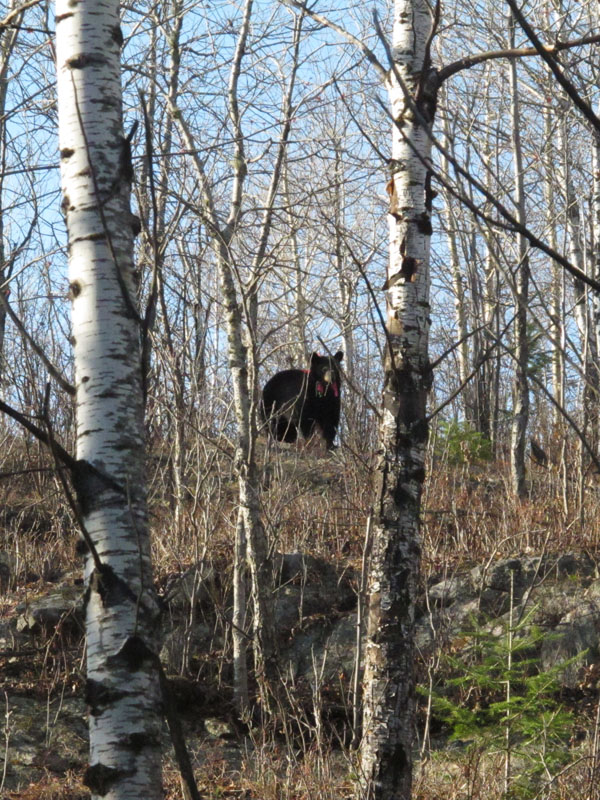
 Shirley watched us from a hilltop - March 25, 2012Cooler. Temperatures ranged from 26F at dawn to 38F in the afternoon. We thought the bears would like cooler temperatures with their thick winter coats, including dense underfur. We located 3 bears from roads by radio telemetry.
4-year-old Jo was active and 1.0 to 1.1 mile northwest of her den. She was in a dense, mostly deciduous, forest area that she used a lot last fall before denning.
2-year-old Sharon was active and 0.9 mile northeast of her den. She’d moved less than a half mile from where we radio-located her 4 days ago.
 Shirley approaches - March 25, 2012
Sharon’s 2-year-old sibling Shirley, who was still at her den when we radio-located her 4 days ago, was now 1.5 mile WNW of her den. We needed to remove her radio-collar so we can radio-collar Faith and not go over the limit of 15 radio-collars allowed by our new permit. She knows us, but we wondered if she would believe “It’s me, bear” and friendly bear sounds. We’d joined up with her many times when she was with her mother Juliet, and we connected with her alone a few times. Would she remember the routine for joining her?
Finally, we saw her watching us from a sparsely forested, rocky hill a couple hundred yards away. She held for us—watching as we approached obliquely so as not to seem threatening. We stopped frequently. Several times, she looked away as if checking her escape route and sometimes started to take a step away. We made familiar sounds. When she couldn’t see us well, she stood on her hind legs to see over a rock outcrop that obscured us. Finally, she pounced toward us with ferocious-looking bluster, which told us she recognized us and wanted to come closer but was still nervous about it. We stopped to help her feel secure, making our familiar sounds and actions. Then she relaxed and calmly approached.
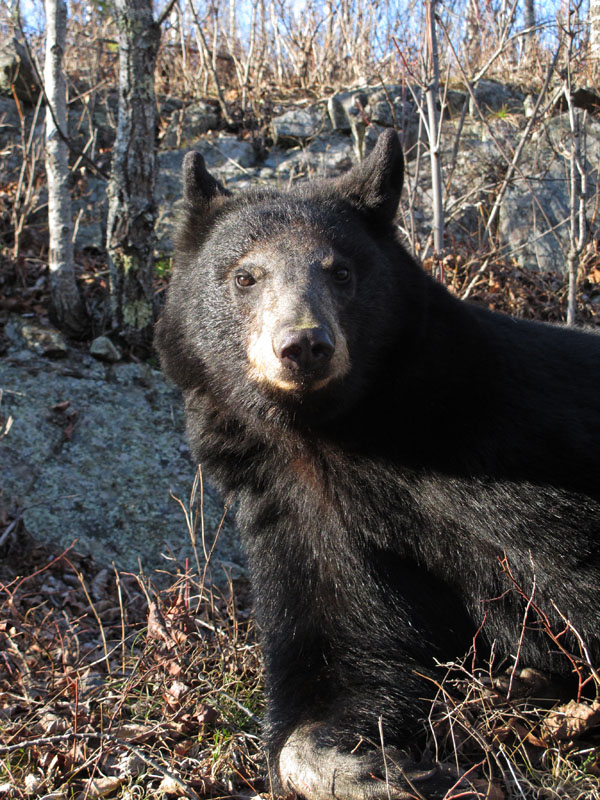 Shirley with pollen on nose - March 2012
 Male willow catkins - March 25, 2012We noticed yellow pollen on her nose and wondered if she had been eating willow catkins. We immediately got into the familiar routine of working on her collar. The ribbons we had attached last fall were still intact. We had used hot pink ribbons that stood up and stood out and were impossible for anyone to miss. We hated to take her collar off, but we now have a limit. We thought of the data this super bear could give, but we also thought how important it is to follow Faith and continue the saga of that family with all its history. As we said goodbye and thank you to her, we watched her walk up and over the hill where we first spotted her today. Shirley is a sweetheart.
At 6:37 PM, Jewel got startled out of a sleep when part of her den roof dropped on her. She went outside at 6:48 PM but returned shortly. Everything turned out okay, it appeared. This is an old den that should hold up okay. She used it both last winter and this winter and it was used by a bear before her. The roof is held together with tree roots. On the other hand, many dug dens collapse with the spring melt. The sandy soil of that immediate vicinity is attractive for den digging. Another old den is less than 200 yards away.
 Male red maple flower - March 25, 2012
 Female red maple flower - March 25, 2012More on the early melt. The average date of Woods Lake (here at the field station) becoming ice free over the past 17 years was April 20. This year it was March 24. We haven’t made date comparisons for red maples blooming, but the male and female flowers on the red maples are the earliest we have ever seen here.
We didn’t see much of what Lily and Jewel and their families did today while we were out in the woods, but the dedicated Den-Watch Team was recording the data.
We’re seeing the donations and help you’ve given in the past few days and feel very thankful. Thank you for all you do.
—Lynn Rogers and Sue Mansfield, Biologists, Wildlife Research Institute and North American Bear Center