
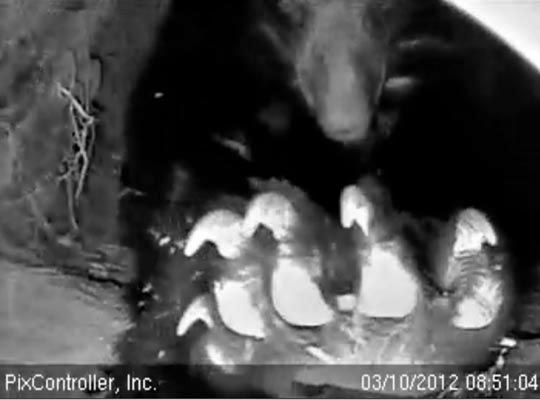
 Count them -- 5 toes! - March 10, 2012Honey and Lucky provided a workshop on bear vocalizations and body language at 7 AM this morning. Honey was facing right and apparently wanted to turn left but was nervous about turning with Lucky right there. As Lucky lay quietly and not looking at Honey, nervous Honey repeatedly blew and clacked her teeth. Lucky responded with moans and whines. Gradually, Honey shifted her position to face left, blowing and clacking all the way. Lucky whined and avoided looking at her. When Honey completed her turn, she added huffing to her repertoire, showing that she was getting over her fear. Lucky then dared to become more active, scratching and stretching as he faced away from Honey, avoiding eye contact. Eventually, both settled down.
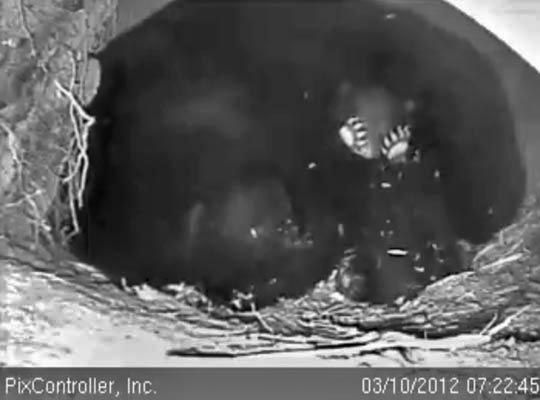 Cub playing peek-a-boo - March 10, 2012We viewed this on the Bear Center’s big screen which has higher definition than the web site. We saw the parts in Honey’s fur on her shoulder that don’t look concerning. We felt sorry for Honey’s angst and for Lucky’s worries about his nervous den mate. Why Honey insisted in crawling in there with Lucky and why she doesn’t just use one of her safe old dens from past years we don’t know. Bears in the wild generally use a different den each winter, too. Sometimes what makes human sense doesn’t make bear sense, and vice versa.
 The North American Bear Center is offering two volunteer Bear Keeper Classes. The class of April 27-29, 2012, is nearly full with 2 places open yet. The class of June 8-10, 2012, has many places open. Each class is limited to 20 people with a minimum of 10. Submission of application does not guarantee acceptance to a class. All applications for both classes must be received by the NABC by March 15th, 2012. Notification of 'Class Participants' will be sent out by April 1st, 2012. For more details and the application, contact
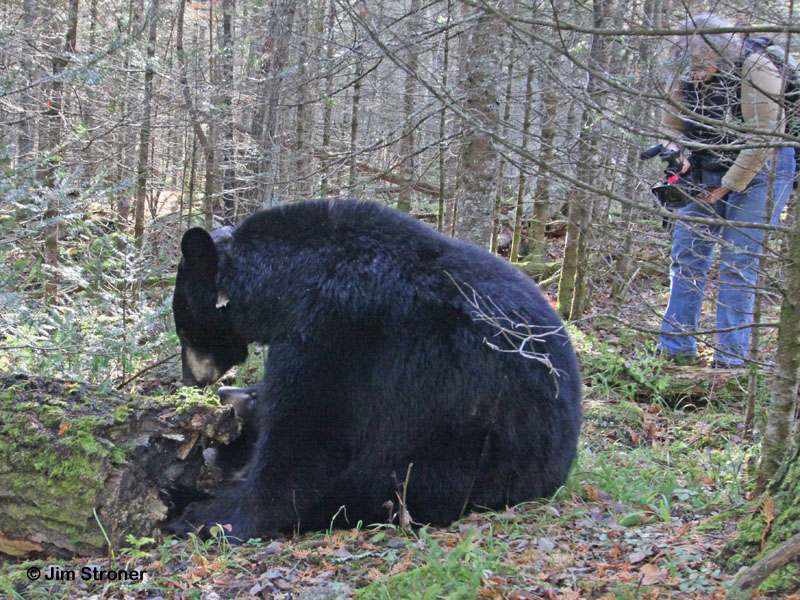 Walking with and videoing Jo and VictoriaWith new Lily Fans joining, it might be worthwhile to tell a bit about why we switched to the kinder, gentler trust-based research methods we now use. Basically, as our research progressed over the decades (starting in 1967), we saw that black bears are not the ferocious animals we had always thought and that we could safely work more closely with them to learn more than we thought was possible before. We gradually and cautiously eased into closer contact. Eventually, we realized we could use the same observational methods that Jane Goodall and Dian Fossey had used with chimpanzees and gorillas. What we had thought was dangerous turned out to be one of the safest jobs in the world, as our record shows. This trust-based research far surpassed expectations. As the bears, including mothers with cubs, became accustomed to our presence, they mostly ignored us. We became inconsequential. We were neither friends nor foes. We were neither competitors nor significant food-givers. We were just there, sharing mutual trust. We used field computers and video cameras to record their lives as they napped, nursed, and foraged, all the while revealing their social relationships, language, and nature. We saw how different their cautious nature is from their ferocious media image.
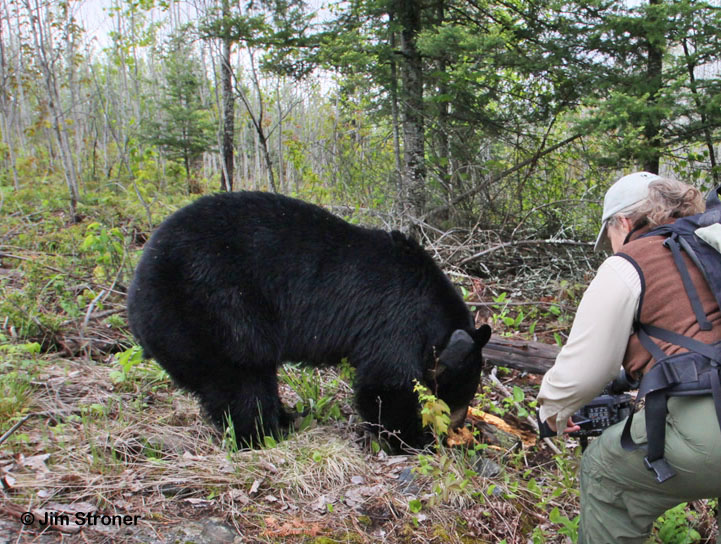 Walking with and videoing JuneThe new research was so different than the studies we had done from airplanes and vehicles to learn movements of bears we seldom saw. What we were learning took us far beyond the data we had previously obtained from tranquilized bears. As you can imagine, finally being able to see the bears we were studying opened the door to all aspects of their behavior. As the videos show, seeing bears go about their lives, investigating their surroundings and interacting with fellow bears finally was revealing the nature of these animals. We learned a tremendous amount, as you can imagine, but the most important thing we learned was that these are not the ferocious animals they are usually portrayed as.
 14-hr walk w/June - Aug 5, 2004 (no longer her territory)Sharing the message that the bears showed us is the most important thing we can do for bears. Sharing the truth about bears is the purpose of the Bear Center and its growing Education Outreach Program. Publishing our reams of data in peer-reviewed journals is the purpose of the fund you are contributing to on bearstudy.org. The bears revealed information that can help all bears forever. As people learn it, fewer and fewer people feel they must shoot every bear that crosses their property. What the bears showed us about their lives and about what is important to them in their habitat can help forest managers manage forests not only for timber but for bears. Through the Den Cams, the bears are revealing the secret half of their lives in their hidden world of winter, and in the process, thousands of Lily Fans are seeing for themselves the nature of these intelligent animals, each with its own personality. We’ll continue discussion of the research and the various facets of it in future updates. Meanwhile, so many of you are spreading the truth about these misunderstood animals.
Thank you for all you do.
—Lynn Rogers and Sue Mansfield, Biologists, Wildlife Research Institute and North American Bear Center