
 Lily with Faith snuggled at her side - Jan 27, 2012Today, Ted hiked out to Lily’s den shed in the early morning light to get the den cam back online. When the cam came up, we noticed Lily and Faith had swapped places sometime while it was down, but we wondered if we’d see any action in the den. Lily surprised us by becoming quite active this afternoon. She began by licking snow—first off her back and then under the open top of the den. Faith fussed as Lily’s actions disturbed her. Lily proceeded to rake and rake and rake more bedding towards their bed before finally settling back in. By then Faith was halfheartedly bawling to suckle, but then seemed to fall asleep again curled up with Lily. A video of these events will be posted later this evening at http://www.youtube.com/user/bearstudy#g/u .
 Lily licks snow that fell into the den - Jan 27, 2012How differently bears hibernate than anyone thought! Today, seeing Lily sitting up and active with Faith begging to nurse, we were reminded again how different this is from what even we thought only a few years ago. When we saw Hope nursing as a yearling in the den, we wondered if that was somehow aberrant. This year we’ve see the same with Faith. And it’s not anything to do with being disturbed. No one has been to their den since the Den Cam was installed on December 18 (40 days ago).
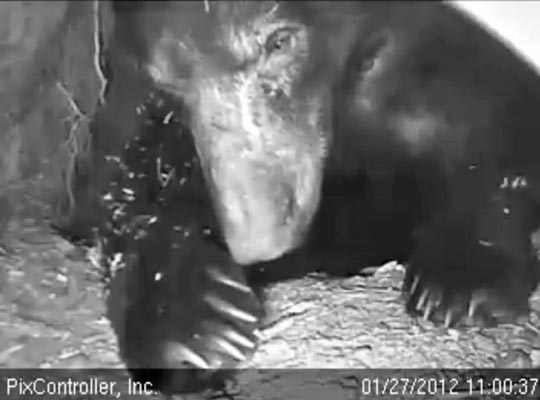 Jewel - Jan 27, 2012Not all bears are this active in the den. We know from the old days of tranquilizing and handling bears that hibernation varies. Skinny bears drop their body temperatures as low as 88 F and drop into such a deep sleep that they were oblivious to a researcher crawling into the den and putting his ear against their chest to hear the slowed heart rate. That’s how skinny bears rationed their little bit of fat through the winter. They undoubtedly were more vulnerable to predation in such a state, but starvation was a greater threat for them than predation.
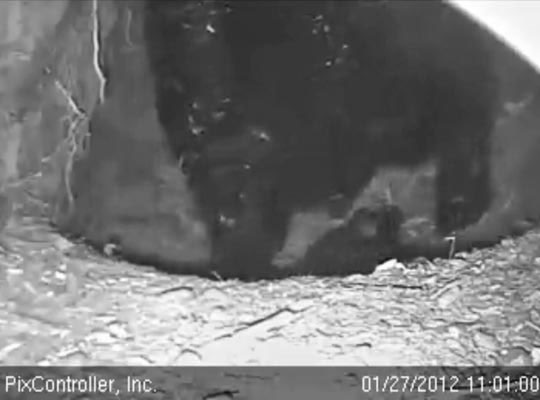 Jewel stands and reveals cubs - Jan 27, 2012Fatter bears were more alert and were the only ones that could produce cubs. They maintained body temperatures in the 90’s and probably were much like we are seeing with Jewel and Lily. In other regions where there can be food available under the snow or where there is no snow, bears are even more flexible in their behavior. Some of the bears in the eastern deciduous forest are active periodically in the winter, especially if there is food available. If starving bears here went searching for food in winter they would simply hasten their starvation. They’re all genetically programmed according to the regional norms of food availability—with some individual variation (think of a bell-shaped curve).
Jewel continues to provide good data on care of cubs in the den. She likely isn’t doing anything different than Lily did, but we have a better view into this den. A video capturing some of yesterday’s den events can be seen at http://www.youtube.com/watch?v=cs7OFcCTys4 .
Our friends at Idaho Black Bear Rescue could use your votes at http://sunsuperdreams.com.au/dream/view/second-chance-at-freedom-for-orphaned-bear-cubs. IBBR provides bear rescue and rehab services to several states as well as sharing knowledge and experience to help bear projects around the world. This contest is just one vote per person, and, with just over 3 days left, every vote counts!
Thank you for all you do.
—Lynn Rogers and Sue Mansfield, Biologists, Wildlife Research Institute and North American Bear Center