
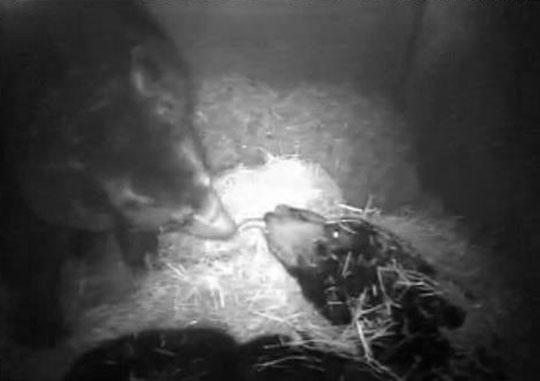
 Lucky extends his tongue to HoneyWill Honey and Lucky reconcile? Today, the Lucky and Honey Den Cam gave a lesson in bear relations and vocalizations. A Lily fan sent the picture of Lucky licking Honey in a gesture of good will. Honey had come over to see Lucky but was filled with high tension. Every move from Lucky brought blowing and clacking from Honey. Lucky extended his tongue at least twice showing his willingness to be friends. Finally, Honey went back to her own side of the den and did some huffing, which meant she was getting over her fear and calming down. Lucky yawned a lot, which might have meant he was trying to dissipate tension. We know we would feel tension if a nervous bear was standing over us that tense.
But it was an interesting gesture for Honey to come over for a visit. Will they ever snuggle together like they did 3 years ago? They have about 3 months to sort things out.
It seems we touched some raw nerves with our mention of Allen Piche and the bears he had been feeding in BC. Lily fans have sent us lots of information and accused us of many motives in mentioning him. Still missing the point. We’re not advocating feeding or not feeding. We’re not supporting or condemning Allen Piche. Our only interest is in the bears, their behavior, and the assumption that the bears killed at Christina Lake were his bears. We don’t care why he was feeding them, whether it was him or his wife that fed them, whether he is a good man or not, or what arrangements he made and didn’t keep with the government to stop feeding. The bears didn’t know any of that.
We only are interested in how the bears were affected and what they did. The more we can learn about that the better. To us, it’s all about the bears and not about things that make no difference to them.
The big underlying fact in all this is that this year was the worst food year for bears in BC that BC bear experts have ever seen. That means bears showing up in unusual numbers in populated areas like Christina Lake. To us, the question was whether they were Allen’s bears or other bears. The authorities assumed (or wondered if) the bears coming into Christina Lake were Allen’s bears. We thought it interesting that Allen has photographic proof that accounts for 20 of his 24 bears after the 18 shootings in Christina Lake. Some suggested he was lying about that to avoid a charge of creating the nuisance bears in Christina Lake. But in a year of very bad food, an increase in bears in a place like Christina Lake would be likely. In our experience, food placed elsewhere, as at Allen Piche’s could reduce the number of bears in another place, like Christina Lake. We want to know more.
Some wondered why we didn’t mention this earlier. Actually, we only learned about it from emails from Allen Piche starting a few days before we put it in an update. We hadn’t yet made the connection that he was the man involved in the marijuana bust, but that wouldn’t have made a difference to us. We are only interested in the bears and what they did.
Some suggested that the bears should have been weaned away from Allen’s place and a fence put up to keep the bears out in the future so as to transition them back to the wilderness. We don’t think those actions would be important. Fed bears don’t forget how to forage for wild foods. Yes, they’ll spend more time at a feeding site like Allen’s in a year of bad food like this year, but that’s only because there is little to eat in the woods. From everything we’ve seen, they prefer a variety of wild foods to dog food and other things people feed bears. The amount of time bears spend at garbage dumps, residential feeding sites, and hitting bird feeders and garbage cans is directly related to scarcity of wild foods.
We’ll continue to follow this ourselves to see how things turn out for the bears. We want to learn. We also want to avoid the firestorms of this touchy subject. We’d rather work on writing scientific articles than deal with accusations that are furthest from our minds.
Thank you for all you do.
—Lynn Rogers and Sue Mansfield, Biologists, Wildlife Research Institute and North American Bear Center