
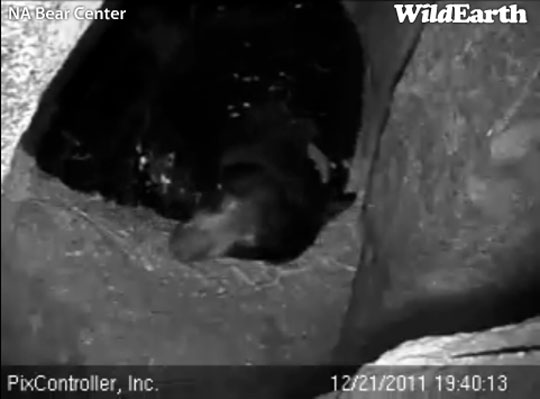
 Lily re-positioning - Dec 21, 2011 After reading comments on our ‘Education, Education, Education’ update of Dec 16, we realize we may not have made our point well enough. Our point was that so often when someone is feeding bears, officials assume that any problems for miles around are a result of the feeding.
Although it is illegal to feed bears in British Columbia, Allen Piche had been feeding bears in a remote area for 25 years without noteworthy bear problems in the nearby community. When Piche was arrested on an unrelated charge, he was also charged with feeding dangerous wildlife and ordered to stop. That summer, bear problems increased in the nearby community and at least 18 bears were shot. Authorities assumed they were from Piche’s place, but Piche went on to identify 20 of the 24 bears that had visited his place regularly.
It’s this assumption by authorities that feeding is the problem that was the focus of our ‘Education, Education, Education’ update.
We are studying the effects of feeding on bears and bear-human relations. Just like the bears in the dens are surprising us with what they reveal, so are the fed bears in this community surprising us—and pleasantly so. The residents probably would not have continued feeding bears here for 50 years now if the results were as bad as many authorities would predict. We checked the data from here for 1996-2005, and complaints were 80% lower than the statewide average.
We’re not advocating that everyone feed bears, but we are gathering examples of diversionary feeding. We heard of an example today but don’t know how to follow up on it. Maybe a Lily fan knows how to help. We heard that the Native People of Attawapiskat, Ontario (near James Bay) respect bears, refer to them as brother, and feed them out of concern when natural food is scarce. We suspect they wouldn’t do that if it made problems. If this is true, we’d like to know details.
Back to Minnesota. Bears with access to supplemental foods have showed us they definitely do not forget how to forage naturally. In fact, they prefer natural foods. A quick comparison of June’s 2010 GPS locations with households known to provide supplemental foods shows she spent 85% of her time foraging out in her territory. Use of supplemental foods increased only when wild foods waned in late summer.
Thinking of Allen Piche, a somewhat similar situation occurred a few years ago in Oregon where it is entirely legal to feed bears. A woman had been quietly feeding bears in her rural yard for years with no problems. Then, in 2008, she saw more bears than usual coming for the food. What she didn’t know was that bear conflicts had nearly doubled statewide due to poor wild foods.
She called a local wildlife official and said she had been feeding for years but was suddenly seeing more bears and wondered what she should do. The official sent an undercover policeman out to ‘help.’ The woman showed him pictures of the bears she had long known without a problem. He looked at the pictures with her and then told her he was an undercover officer and had to confiscate them for evidence.
With no proof, officials began telling those within several miles of her home that she was the cause of any bear problems they might have.
Although it is legal to feed bears in Oregon, she was charged with disturbing wildlife and 9 counts of endangering the public. Neither law had been used in that way before, so there was no way she could have known she was violating them. The way the ‘disturbing wildlife’ law was applied, anyone who feeds birds could be found guilty of disturbing them. Lynn was called on to provide expert testimony.
A few days before the trial, Lynn was at the 10th Western Black Bear Workshop in Reno, Nevada, hearing an Oregon wildlife official present a report on the great increase in human-bear conflicts that had occurred statewide in 2008, noting, “Conflicts associated with black bears have increased recently. The Department believes this increase is primarily a result of two successive years of poor forage availability for bears due to unusually late springs followed by dry summers.”
The report would have destroyed the state’s case blaming this woman for the bear problems. Lynn presented it at the trial. The judge refused to admit it as evidence.
Thanks mostly to Lynn’s testimony on the lack of serious danger from black bears, the woman was found not guilty on the 9 charges of endangering the public. However, she was found guilty of disturbing wildlife by feeding them.
The judge fined the woman thousands of dollars and barred her from coming within 7 miles of her home for 3 years. There was no evidence that any of the bears that caused conflict in the area had been to her place. Her two closest neighbors had no problems. There was no greater increase in problems in her area than anywhere else in the state in that year of scarce food.
Authorities prosecuted her on the basis of their assumptions about bears and were backed up by a judge and jury with similar beliefs.
There is a need for education. There is a need for authorities to base decisions on science and evidence rather than assumptions that are widespread but mostly without scientific backing. There is a need for research to provide the science and a need for biologists to keep open minds about the needed research rather than trying to squelch research that conflicts with their beliefs.
Den Watchers Needed!
As we write this Faith is bawling to nurse. So far, Lily is ignoring her. We are already seeing things in the den that surprise us. The Coordinators of the Den Watch are set up and ready to accept volunteers. If you are interested in volunteering to systematically record observations of vocalizations and behaviors in the den fill out the form here http://tinyurl.com/den-watcher.
Thank you for all you do.
—Lynn Rogers and Sue Mansfield, Biologists, Wildlife Research Institute and North American Bear Center