
 rock den explored by June and cubs (2005) and briefly used by Cal (2008)Today, we checked a rock den that Sue watched June and her cubs Pete and George crawl in and out of in the summer of 2005. We had trouble finding it because we didn’t have it marked with GPS coordinates, but we searched until we located it. It was empty but it looked like another bear had used it in the past couple years, and it was most recently used by a porcupine. Now we have good GPS coordinates of the den.
In October 2008, June’s yearling Cal used it briefly before moving to a different den for the winter. The den he moved to just happened to be the den where June gave birth to her first litter (Pete and George) in January 2005. That den is also the one you can see June digging on July 19, 2004, in the video at http://www.bear.org/website/bear-pages/black-bear/hibernation/20-digging-a-den.html.
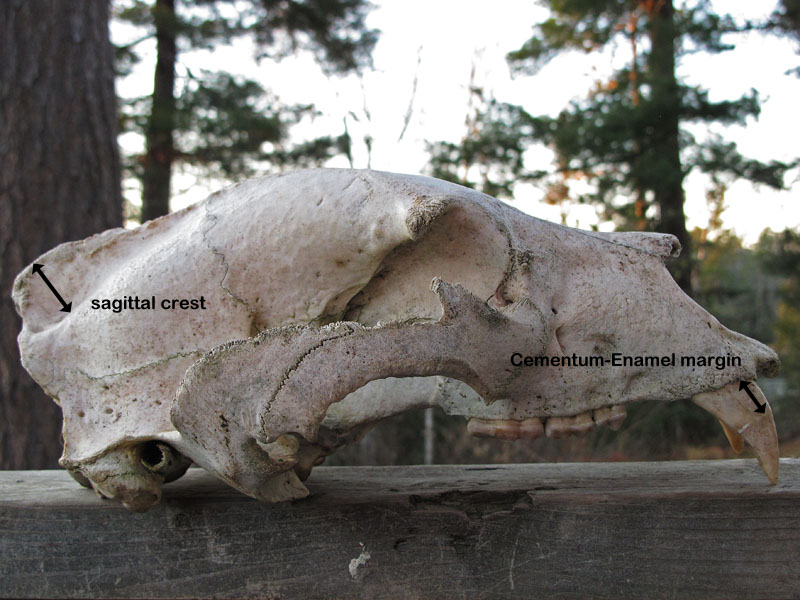 old male bear skullThe story of the skeleton probably begins August 31, 2009. On that date we found and followed a blood trail about 400 yards until we lost it in a marsh. This past weekend, 200 yards farther on, a deer hunter came upon a weathered old skeleton. The hunter contacted us and gave us the skull.
 old bear tooth - large C-E marginThe skull is from a big old male. We could tell it was big because the skull was only a quarter inch short of being big enough to be recorded in the Boone and Crockett Awards Book. The skull was exactly 12 inches long and 7 ¾ inches wide. We could tell it was a male from the size of the skull and from the large sagittal crest. We could tell it was old from the wide Cementum-Enamel margin on the canine teeth. The C-E margin is the distance from the bone socket to where the enamel starts on the crown of the tooth. Enamel covers the crown and cementum covers the root. As bears get older, the root continues to grow, the tooth continues to erupt, and the edge of the enamel gets farther and farther from the bone socket. On this tooth, it was over a half inch, which is very big. We’ll get a tooth sliced and stained at Matson’s Lab in Montana so we can count the rings to get this old bear’s age.
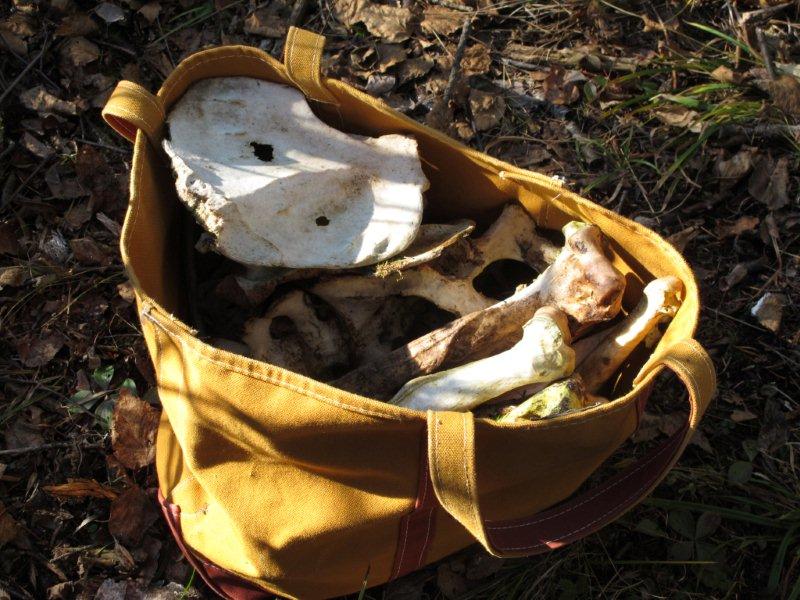 bear bones - note scapula with 2 holesThe hunter described the place where he found the skeleton—a place we know—so we went to investigate. Many of the bones were half buried under 2-3 years of rotting forest litter, putting the time of death at the right time to fit the bear we had tracked before leaf-fall in 2009. We collected all the bones we could find, including a scapula with 2 holes in it, but some of the bones have been carried off.
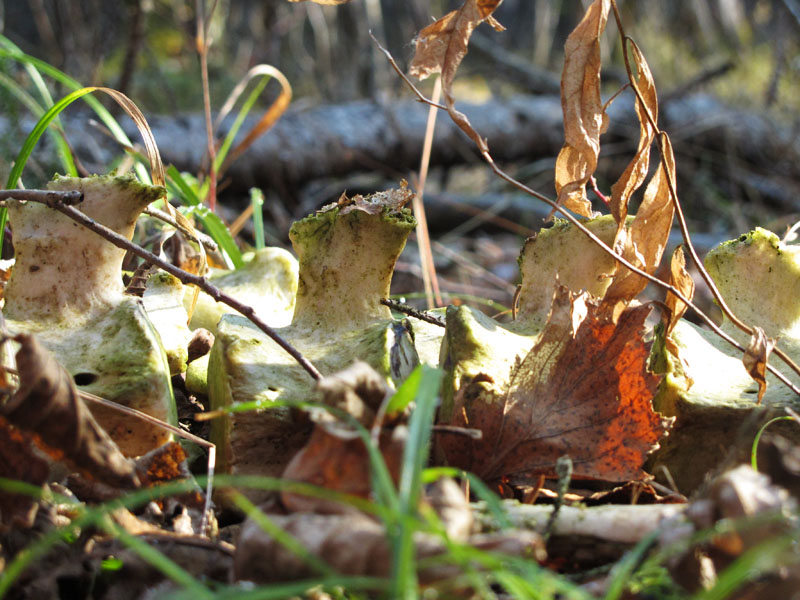 vertebrae in leaf litterTwo bears disappeared that fall of 2009. One was BB King, the 12-year-old son of Shadow. BB was limping badly and had an infected old wound when we first saw him that summer. He was thin enough that his neck was smaller than his head, so we radio-collared him to monitor him and administer antibiotics. When we found the blood trail, we immediately checked on BB King’s signal, and it wasn’t him. The other bear that disappeared that fall was Lumpy—the biggest, most dominant bear in the area. He’s the one in the video winning a fight with One-eyed Jack over Midge back in 2006 when old Midge was only 23 (http://www.bear.org/website/bear-pages/black-bear/reproduction/14-mating-battle-combatants.html ).
The good news is that an anonymous donor will match dollar for dollar any donations to the Wildlife Research Institute and North American Bear Center in the upcoming GiveMN.org Give to the Max Day. The anonymous donor will match donations to a maximum of $50,000 for each organization (WRI and NABC). Lily fans amazed everyone (including newspaper reporters) last year by putting the North American Bear Center in 2nd place in Give to the Max Day. This year, GiveMN.org is offering 1st, 2nd, and 3rd place prizes of $15,000, $10,000, and $5,000 to the 3 small non-profit organizations that receive the most dollars. We have no idea what will happen this year. Give to the Max Day is Wednesday, November 16. The money will help expand the Education Outreach Program.
Thank you for all you do.
—Lynn Rogers and Sue Mansfield, Biologist, Wildlife Research Institute and North American Bear Center