
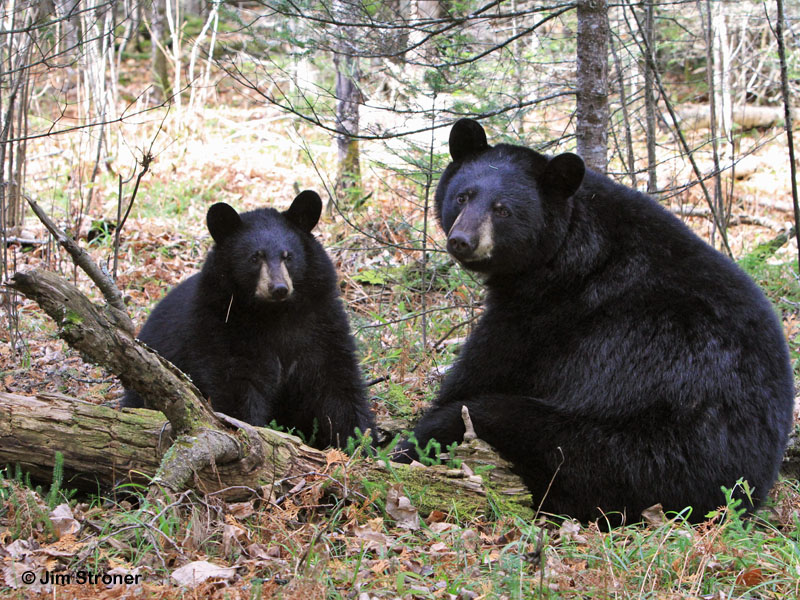
 Today we walked with 3-year-old Jo for the first time. She was so calm we had to keep reminding ourselves that it was the ‘first time.’ With this walk, Jo officially became a ‘Level 3’ research bear.
The research bears can be grouped into 3 levels depending on their tolerance and degree of habituation. Level 3 bears are by far the most important to the research—the ones we can learn the most from. Bears can move from one level to another, but not all bears make it to Level 3. Let us explain.
- Level 1 bears can be collared but cannot be approached in the woods.
These bears are relaxed and easy to collar at the field station, or, in the case of yearling cubs, in the presence of their mother. We can collect telemetry location data on these bears but we generally don’t put GPS units on them because we can’t approach them in the woods to change batteries. These bears are generally young bears still trying to establish themselves.
- Level 2 bears can be approached in the woods but cannot be walked with.
Although these bears can be approached, some need to circle around and pick up our back trail before they are comfortable coming to us. Others wait patiently for us to approach. Still others recognize our voices and come to us. This allows us to change GPS batteries or adjust collars as needed without tranquilizers.
- Level 3 bears can be walked with.
It takes a bear with a special temperament to tolerate being accompanied. Our goal in walking with a bear is to be part of the scenery—to be there but not be in the way or influence the bear’s movements. We’ve learned to anticipate movements and the tolerances of individual bears so natural behaviors can be observed and recorded. Even those bears that tolerate being walked with have different comfort zones.
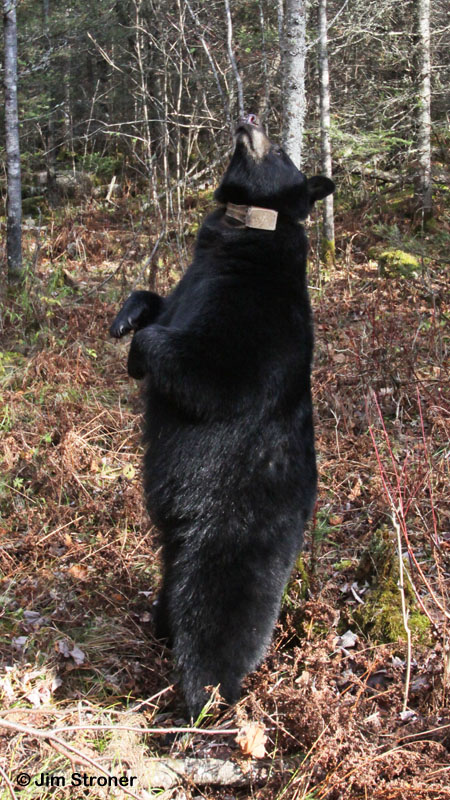 We joined up with Jo today to adjust her collar. She is the only GPSed bear that hasn’t settled into a den site. After we fixed her collar, she and Victoria played and played—then Jo headed off. We followed, not knowing how she would react. She didn’t run away or keep looking back like some bears do. She simply ignored us. If fact, she was so easy to walk with, we had to remind ourselves it was Jo we were walking with and not June!
Jo carefully sniffed vegetation and branches like we have seen other female bears do at this time of year. She also straddled a dozen or so saplings, back-rubbed 2 trees, and stomp-walked—all forms of marking behavior. Marking by female bears seems to peak in the fall.
Eventually, Jo led us to a small but deep (5-6 feet) depression. She climbed down in and began digging into the south-facing slope. She then climbed back up to paw and nose the ground just above. Nearby, she dug briefly again. We hoped she would continue, but, instead, she circled back to the huge white pine where she and Victoria had spent the night. As soon as she got there she sat and offered herself up for nursing. After the nursing bout, they both rested and we bid them “Thank you, bears” and headed back.
No change in Lily’s or Braveheart’s locations today. Lily is still at the rock den.
Team Bear has disbanded. This fundraising team formed spontaneously over a year ago and worked hard to put together fundraisers that raised over $40,000 to reduce the Bear Center debt. A huge thank you goes out to the over 20 members for all they’ve done! After more than a year of providing leadership, Jill Wheaton Lindsey felt it was time she stepped back and became a Lily fan. Jill, thank you for all you have done and will do, and thank you to all the Team Bear members who have worked so hard.
Thank you for all you do.
—Lynn Rogers and Sue Mansfield, Biologists, Wildlife Research Institute and North American Bear Center