
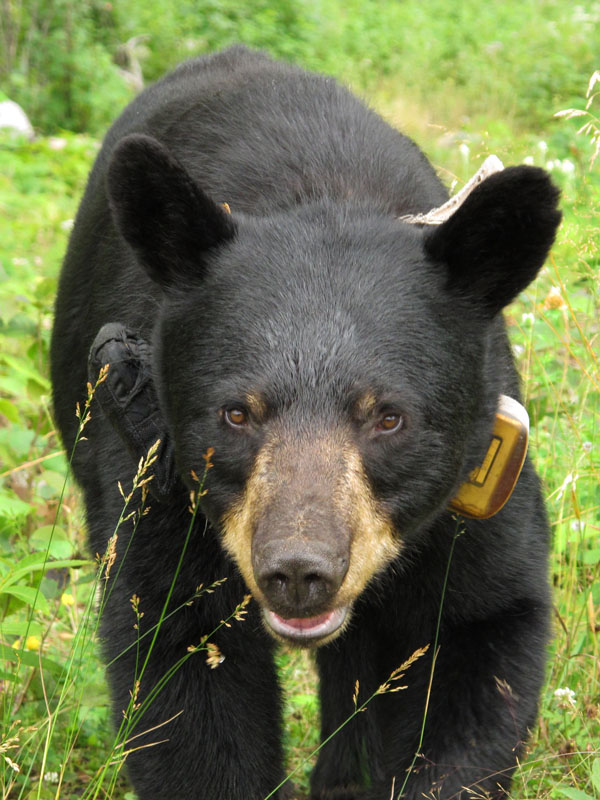
 We continue to be thankful that June’s eye is looking so much better (left). Looking closely at it, we can see differences, including the opaque area still there, but she is using the eye, giving us hope for further improvement. Our veterinary advisor says we should keep up the antibiotics for another week, which we’ll do, of course. Today, for the antibiotic dose, she was again in an old clearcut that has been taken over by raspberries and rotting logs (ant colonies). These openings are certainly attractive to bears this summer.
But did someone famous say, “To every thing there is a season, and a time to every purpose under the heaven,” or did we just make that up? Either way, habitat preferences change with the seasons and every habitat has a purpose. Soon, chokecherries and round-leafed dogwood berries will be ripening, drawing bears to other habitats as ant reproduction wanes. The cold spring dampened hornet reproduction for this year, so those won’t be drawing them much. Raspberries keep fruiting all summer, so those will be competing with the chokecherries and dogwood berries, but raspberries are harder to pick because they grow more or less singly while chokecherries and dogwood berries grow in bunches. We expect to see more of those berries in the scats soon.
 Hazelnuts are a bit of a disappointment this year. We never get our hopes up a lot for hazelnuts because they have good crops less than once every five years. When they’re abundant, bears disappear into the hazelnut patches and end up producing a lot of cubs. Many young females produce their first litters following a big hazelnut crop, and that synchronizes reproduction for the next several years, making good cub crops occur every other year for awhile. But this year, we’re seeing hazelnuts on the bushes untouched. Closer examination shows them to be empty shells. We’re blaming filbert worms (Cydia latiferreanus), but we don’t know how to predict when their numbers will be up or down. They begin life as an egg in the hazelnut flower, grow up eating the developing nut, and then exit the empty shell in late summer. The empty shells now have holes in them. Bears can tell in an instant whether a nut is good or empty. They find them largely by smell, and apparently empty shells don’t smell like food.
You put the thermometer over $652,000, meaning there is only $48,000 debt left. What a huge thing you all have done over the last year and a half. We never expected anything like that. We never expected any of it. So many wonderful things have happened these past 18 months. And now we are seeing the Education Outreach Team’s enthusiasm for making the most of our opportunity to speak at the Minnesota Education Association Conference. The MEA represents 70,000 Minnesota teachers and the conference is attended by 8,000 to 9,000 of them. Sometimes it’s one good thing after another.
To vote for America’s Favorite Park, go to http://m.livepositively.com/park_details.jsp?parkId=556 and vote over and over.
Thank you for all you do.
—Lynn Rogers and Sue Mansfield, Biologists, Wildlife Research Institute and North American Bear Center