
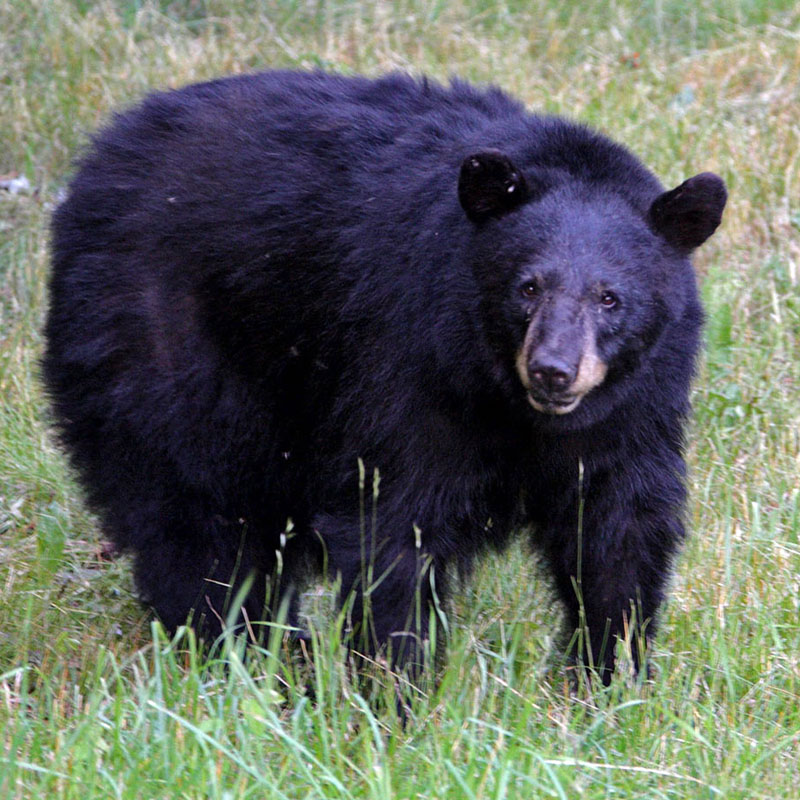
That made us wonder if she was old. We gave her some food and lifted a lip to see her teeth. “Wow!” Lynn said, “She might be the oldest bear we ever saw!”
What Lynn saw on her upper canine tooth was a distance of over an inch between the gum line and the cementum-enamel margin. To explain, enamel covers the crown and cementum covers the root of a tooth. Where the two meet is at the gum line. But as bears age, where they meet creeps away from the gum line as the root grows. Midge was old—26 ¾ years, as it turned out.
We gave her a radio-collar and called the University of Minnesota’s Veterinary Diagnostic Lab. We said we believed an old bear was dying and that we knew of no thorough autopsy conducted on an old black bear that died of natural causes. No one knows what kills old bears.
We thought we were seeing her last year of life. We hoped she would return to her territory and show us where she had come from to invade Shadow’s domain those 6 years. We thought she would likely die in her den, and we hoped we could get to her before she deteriorated so she could contribute knowledge about what kills old bears.
We remembered the last time we wondered where an invader came from. We gave her a radio-collar and ended up tracking her 44 miles north to her territory in a remote part of Canada.
We didn’t learn anything like that from Midge, though. She traveled only two and a half miles into Braveheart’s territory before she felt the need to cool her feverish body in cold pools in a cedar swamp. She died half immersed in an icy pool in November. The cold water kept her from deteriorating before we discovered she was dead.
Three of us dragged her out after dark and began the 250-mile trip to the Veterinary Diagnostic Lab. A graduate student waited up until after midnight to meet us and put Midge into their cold room.
The autopsy suggested that her main problem was immune deficiency. The immediate cause of death was blastomycosis—something every bear in this area is exposed to but no wild bear has been known to catch. What makes that more astounding around here is that this is an endemic area of “blasto” with lots of dogs and a few humans catching it each year. A literature search showed that immunosuppression is the main contributing factor in blastomycosis infections.
Midge also had hair loss caused by a hair parasite, Pelodera dermatitis, which we had never heard of before. She had lice, which we seldom see in bears.
One thing we were anxious to see during the autopsy was her aorta. Would this old bear have any plaque? No. It was squeaky clean. We had looked at other aortas over the years and never seen plaque in them, either. But none of them were half Midge’s age. What makes that interesting is that our earlier studies showed that cholesterol and triglycerides average 351 and 355, respectively, during hibernation. That’s high, but no atherosclerosis, and nobody really knows why.
The Lab did an outstanding job and they are now partnering with us in writing this up for a peer-reviewed veterinary journal.
More about peer-reviewed papers in future updates.
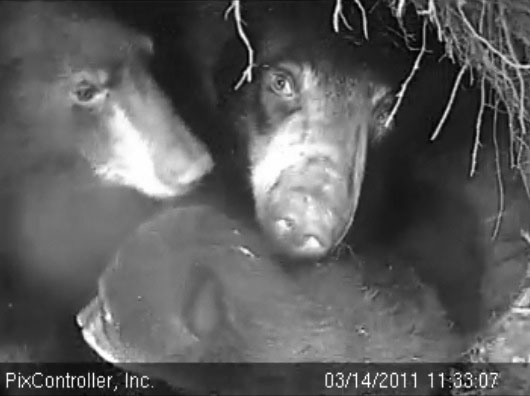
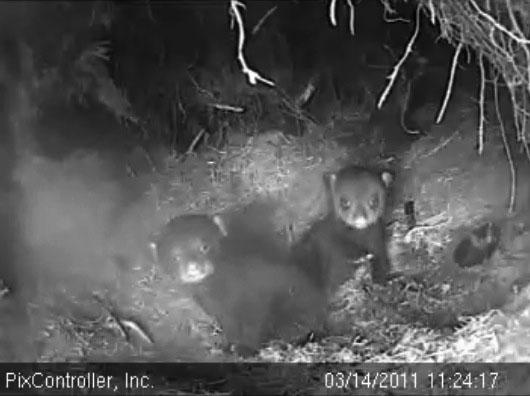
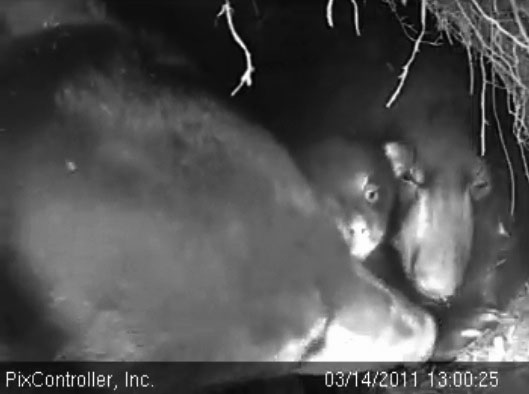 We regularly keep the den cam running in the corner of our computer screens while we work on other things. Today, ‘try to work on other things’ would be more accurate—the den activity was particularly distracting! Lily and Hope seemed to play nearly non-stop on this warm day. They both did stints outside, and while Lily was out we watched a touching play scene between Hope, Jason, and Faith. We watched as Jason and Faith seemed to participate in the play – at least as well as 7-8 week old cubs can! Their nervous systems are still developing and their jerky movements show they don’t quite have control over their extremities yet. They crawl pretty well but walking is a real challenge. But they are doing wonderfully well and seem to be thriving with the extra attention they get from Hope. And they seem to really like their big sister and seek her out.
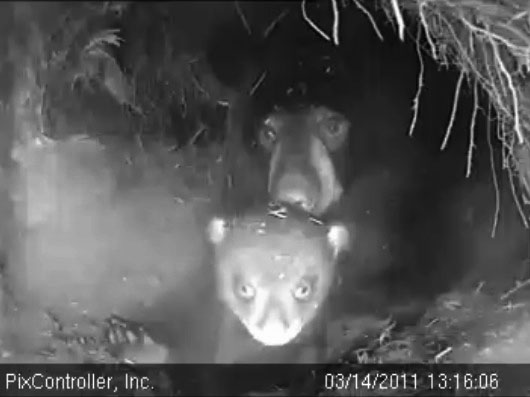 The warm weather is slated to hang around for the next several days, so we’ll likely see more excursions outside the den from Lily and her crew. We are thankful for the pan-tilt-zoom camera outside the den! Today when we turned it on we were surprised to see Lily standing up checking out the camera. The camera goes through a positioning routine – and as it panned down all we could see was black fur! She checked it out but thankfully left it in tact. Not so for the den cam, though. She managed to make some adjustments to that one!
Part 1 of the video footage from today is posted on the 'bearstudy' YouTube account at http://ww
Thank you for all you do.
—Lynn Rogers and Sue Mansfield, Biologists, Wildlife Research Institute and North American Bear Center