
 Dennis Anderson’s great Op Ed piece in the Minneapolis Tribune yesterday said that little science was coming out of this research project. By that he meant peer-reviewed papers. It’s true. Although Lynn has senior-authored more peer-reviewed papers on black bears than anyone, he hasn’t senior authored one in the last decade.
Why not?
The reasons include (1) a slow start on the current research project due to early restrictions on the number of radio-collars by the DNR, (2) a setback of several years when 2 of the 3 radio-collared bears were shot by hunters in 2000, and (3) the deaths of 9 radio-collared bears since 2005—6 from hunters, 2 by vehicles, and removal by the DNR of one that denned under a vacant house.
But some of the lack of publication was our own choice. We viewed it as more important to change public attitudes about bears than to write technical papers that on the average are thoroughly read by only 6 people. Public attitude is the key to coexistence. Changing public attitudes can only be done by reaching the public. So we focused on creating an educational website, creating the North American Bear Center, and reaching over a hundred million people a year through TV documentaries. In the last year, we added Den Cams, daily updates, and (with your help) an Educational Outreach Program. We also were writing a book until the protection effort took over.
Meanwhile, technological advances are enabling us to obtain more data than ever. GPS units on the radio-collars now send exact locations to our computers every 10 minutes showing us the habitat, speed of travel, and distances from roads, human habitation, and other radio-collared bears. To verify activities, we join some of the bears. This requires announcing our approach. If we don’t, they disappear. If we do, bears like June and Lily will identify us, ignore us, and go about their lives. Technique and technology are combining to show us more about black bear life than ever before. That is why protection of radio-collared bears is so important.
But along with the protection effort, there is pressure to show why it is important to protect those bears. For some, importance is measured by peer-reviewed papers. It’s time to write some. Two of the topics relate to diversionary feeding which has become a topic of growing discussion. It is a topic at two international conferences on bear research and management this year. Lynn is an invited speaker at both. One of the conferences focuses on polar bears which are having a harder time catching seals due to global warming. They are increasingly being attracted to native villages. The conference will explore the feasibility of using diversionary feeding as a tool to reduce the human-bear conflict.
We’ll talk about other topics in future updates.
Meanwhile, protection occupies much of our thought. We are gratified to see your letters to officials and newspapers. Team Protect, Team Bear, and the Educational Outreach Team are working behind the scenes.
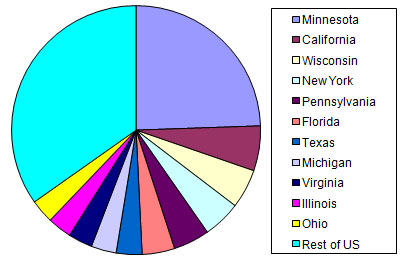
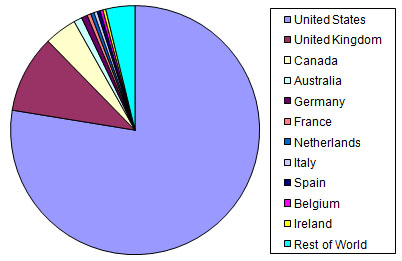
Julia Attwood has worked hard to summarize the results of her petition to date (pics above). Minnesota residents account for 24.5% of the US responses, and the US accounts for 77.6% of the 87 countries represented. What an effort you all are making. Thank you so much!
Did you know you can have these updates emailed to you? Just check the box for ‘Daily Updates under ‘Our Mailing Lists’ on the front page of www.bearstudy.org towards the bottom of the page.
Thank you for all you are doing.
—Lynn Rogers and Sue Mansfield, Biologists, Wildlife Research Institute and North American Bear Center