
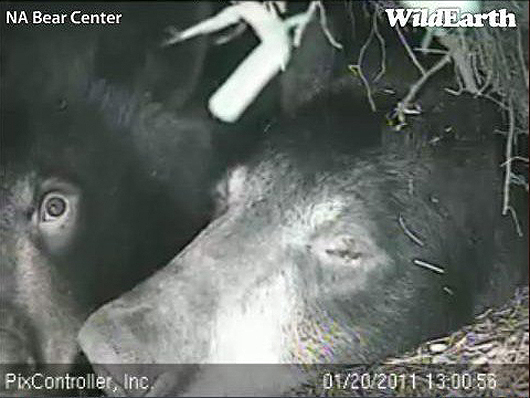
 Has labor begun? We think so. At 5:08 PM, Lily began clenching her teeth. That was what signaled the beginning of labor last year. Hope’s birth came a little over 22 hours later. That would put the birth(s) tomorrow—January 21. The forecast tonight is for wind and temperatures down to minus 40. The den is no warmer than outside. The piece of vegetation dangling in front of the camera is moving in the breeze.
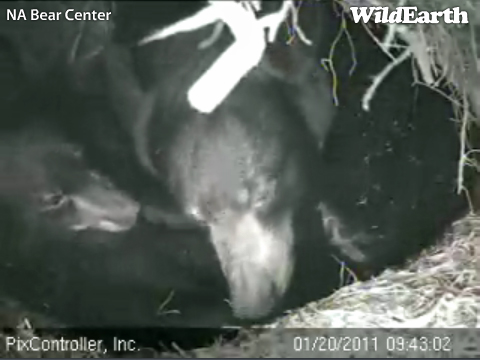
How do sparsely furred cubs survive? They snuggle under mom and huddle against her sparsely furred underside while mom tucks her head under her chest and breathes on them. Will Lily respond to the cubs’ cries and hums, or will she be swayed by Hope’s bawling to nurse? We’re betting she does the right thing and keeps the cubs warm.
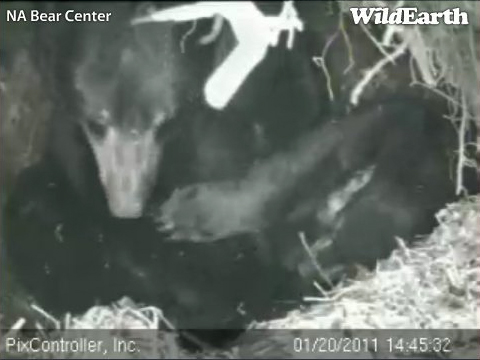
Last winter, when Hope was newborn, we all saw how Lily responded to a newborn cub’s cries. When Hope hummed her nursing song, Lily didn’t move. Humming signals all is well. When Hope cried out, Lily moved to fix the problem. She snuggled Hope from cold drafts, helped her reach nipples, and licked her hindquarters to stimulate urination and defecation.
What timing! Today’s full moon was the start of the Bear Moon when black bears give birth. Brother bear is prominent in Native American culture as evidenced in part by their naming a moon for the bears. Native American folklore also holds that snowfall during the Bear Moon means cubs have been born and the mother is calling for snow to wash them. Snow is in the forecast. We hope that means tomorrow will not be as sunny as today. Bright sun makes the solar panels generate more electricity than the charge controller can quietly handle. That’s what makes the whine in the sound some days. We don’t want the whine to drown out the cubs’ first cries.
 Rebecca Hamilton found this about colostrum. “Compared to the later mature milk, human colostrum is richer in protein and salts, but lower in fat and sugar. Colostrum is high in immune globulins that help newborn mammals acquire immunity to certain infections. In calves, immune globulins appear in the blood within 3 hours after colostrum is ingested. Immune globulins pass from food to blood without destruction during the first day or two after birth. Trypsin inhibitors in colostrum allow the immune globulins to reach the intestines and move on to the heart without destruction.”
Lily and Hope were on the front page of the Minneapolis Star Tribune today. A teaser was on the front page, with the full story on page B3 http://www.startribune.com/local/114244864.html?elr=KArksUUUycaEacyU
Our partner Verizon put out this blurb http://www.gearlog.com/2011/01/verizon_streaming_bear_birth.php
WildEarth.TV in South Africa says Ted and Lucky’s den cam debut is coming soon—maybe tomorrow, in which case the debut may be overshadowed by Lily and company doing their thing.
The Education Outreach Program is growing. At first it was a questionnaire. 459 responses came in saying teachers were using the den cam in their classrooms. The comments sections provided good ideas.
The questionnaires turned into the Education Outreach Program. Teachers submitted lesson plans, fine tuned power point presentations, and created videos. Other teachers brought service learning and counseling into the fold. The Black Bear Box team created boxes that are now being pilot tested in classrooms. The boxes should be available for broader classroom use by March.
Now, thanks to dedicated team work, we can divide into sections. Bear boxes, lesson plans, technology, service learning, and counseling will have specialists heading their sections. The team will follow up on the questionnaires from last year while posting a new questionnaire for teachers to share their ideas and create lesson plans.
Is this overly ambitious? Maybe, but at the same time, we are scaling back. The art of success is in doing the possible—not dreaming the impossible. For now, lesson plans will focus on the bears we know and the sources we trust—black bear information on bear.org and bearstudy.org. Other sites have good information, too, but where it is hard to separate facts from misconceptions, lesson plans can be developed most quickly using the information on bear.org and bearstudy.org. For more information, check the education link on bear.org http://www.bear.org/website/education/educational-outreach--curriculum-project-preview.html.
Thank you for all you have done and continue to do.
—Lynn Rogers and Sue Mansfield, Biologists, Wildlife Research Institute and North American Bear Center