
Bear news from the North American Bear Center
November 4, 2010 – 8:58 PM CDT
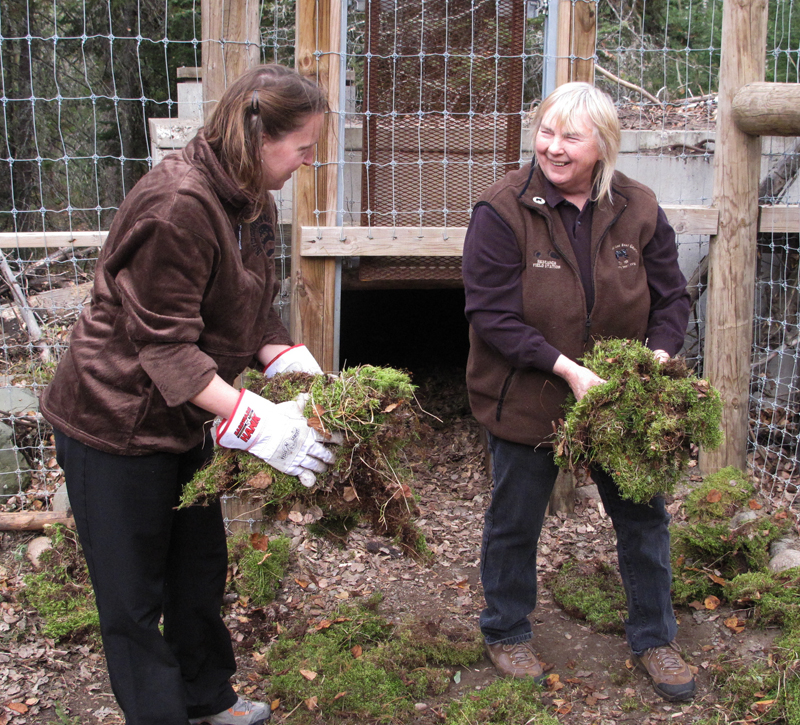 On October 21, when the staff at the Bear Center learned that a wild bear, 10-year-old Dot, had used moss for bedding, Ella Ingram, a visiting professor of education, and Sharon Herrell, the program director, gathered moss and put it in the denning area. Little Lucky proceeded to rake it into the den he will share with his friend big Ted.
On October 31, the three bears each stepped onto the scale. Big Ted (13) weighed an even 700. Honey (14), the female, was 492. Little Lucky (3), a male, was 328 pounds and he wanted his bed to be just right. Since then, Lucky has mostly stayed in his den of moss. Only once did he accompany Ted when Ted made his daily appearance away from the den. Honey is spending a lot of time in her separate den by the viewing windows. The back of that den is open to the windows, so visitors to the Bear Center can see her.
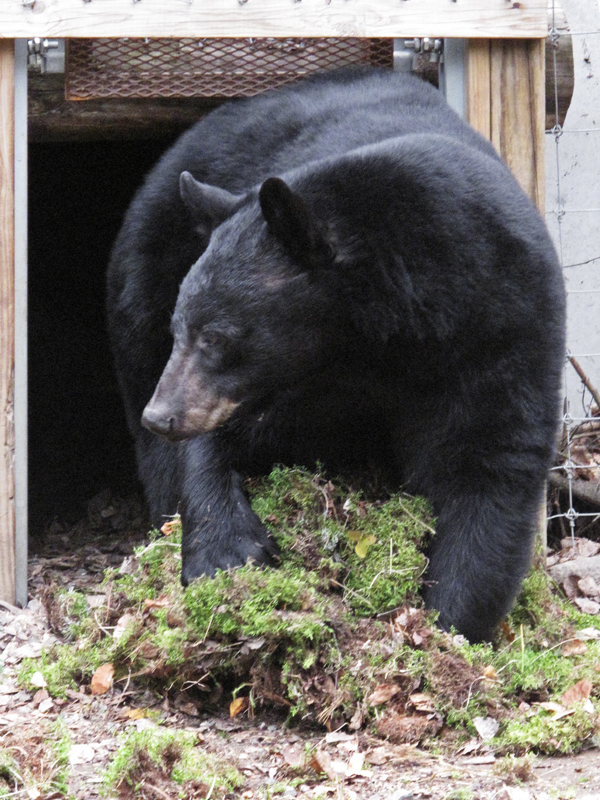 The dens have only natural leaves and moss for bedding, no straw. People gathered bags of leaves and moss, dumped it outside the dens, and the bears did the rest. They will probably make appearances through Thanksgiving. We are working on a camera for Ted and Lucky’s den to show on a monitor in the Bear Center and possibly on bear.org.
Dr. Garshelis kindly provided background on the 13% wounding loss in Washington that we mentioned in last night’s update.
“Lynn, I would like to comment on the update that you posted, and sent to Dennis Simon, Commissioner Holsten, and Representative Dill. It is a shame, in my view, that you continue to pursue the “wounding loss” angle to your argument to protect collared bears.
I was well aware of the Washington study that you mentioned – I have cited it a number of times, and know the first author personally (I visited him during his study). His study was designed, in large part, to assess the effects of a ban on baiting and hound-hunting on the bear harvest. He reported a high wounding loss rate, but did not say whether this occurred both before and after the ban on these hunting techniques (obviously both bait and hound hunting enable hunters to take shots at closer range). He did specifically comment that the wounding losses were due to hunters not being able to find dead bears in the thick vegetation. Indeed, the wounding loss was 20% in the rainforest of the Olympic peninsula, where they have 150 inches of rain per year. Wounding loss was 0% on their study area with just over 20 inches of rainfall – more similar to the conditions across the bear range in Minnesota. Due to these important factors, one cannot just transfer data from one place to another. Since we have data in Minnesota – in fact the largest sample that I know of anywhere in North America (270 hunter kills of collared bears, 5 not recovered = <2%) – the results of studies from elsewhere are irrelevant. (Likewise, the nuisance kill in Washington – 24% overall – is 3-4x greater than in Minnesota).
If you are trying to educate an audience of 200,000 people, it is important to get all the facts, and not let your fans – who came up with this article – drive your arguments. We are only discussing whether collared bears in Minnesota should be protected, so let’s just look at the data from Minnesota.
Furthermore, if you argue the case that the collared bears are very clearly marked and easy to see -- so it would NOT be an extra burden on hunters to identify them as such -- then it seems counter-productive to argue that forcing hunters to avoid collared bears would make them more careful in the shots they take, thus reducing wounding losses. Dave”
Dave has a good point that dense vegetation makes it harder to find bears after they have been shot.
On the subject of protecting radio-collared bears, we realize that it’s easy to see ribbons (and usually the radio-collars themselves) on the study bears. But the argument we keep hearing, often from officials, is that looking for collars and ribbons might be too much of burden for hunters. We say that looking twice should not be considered a burden. Most hunters consider it good hunting practice to not only look for a collar but to take the extra moment to make a clean, killing shot and avoid a shot that just wounds a bear. We can add to the discussion on wounding next week when we get information from Ontario where habitat is very similar to Minnesota’s.
Thank you much, Dave, for your input. Always interesting. Every fact makes the picture a little clearer.
On another subject, a Lily fan forwarded an excellent article http://www.onlinedigitalpubs.com/display_article.php?id=465460 on habituated bears. Authored by Sherry Simpson, it appeared in the September 2010 issue of Alaska Magazine. The article is unusual because I couldn’t find one error in it (except that some of the lines got mixed up in the printing, making it hard to follow in a couple places). The topic of habituation is often fraught with misconceptions. Not this article.
It points out that bears that have neither positive nor negative experiences in repeated exposure to people learn to ignore them and go about their business. They don’t become more likely to attack. The author is writing about the habituated brown/grizzly bears in Katmai National Park where the big bears ignore observers and pay attention to things that really count in their lives.
We mentioned the article here because what the author says about the brown bears holds for the black bears in this study. They mostly ignore us, and that’s what enables us to do the kind of research we do. Usually, we are inconsequential to the bears. They go about their business, even with video cameras in their faces. If we need to work on their radio-collars, etc., we offer a handful of nuts and do what we have to with the radio-collars. Our work on the radio-collars is associated with the positive experience of eating the nuts. They ignore us. They finish the nuts. They go back to their business, and we go back to being ignored.
The author did a great job. Just the truth and nothing but the truth, and that’s unusual in articles about bears.
Meanwhile, you are working behind the scenes in many ways and we thank you for all you are doing.
—Lynn Rogers, Biologist, Wildlife Research Institute and North American Bear Center