
Introducing Dot
October 18, 2010 – 9:42 PM CDT
Lily tantalized us by making a move toward her den a few minutes ago. After spending the day in a small area, she lined out 0.2 miles on a bearing of 83 degrees. The den is another 1.6 miles on a bearing of 76 degrees. Should we be excited? After her other false starts, she is going to have to show us more than this to truly make us believe she’s making the big move. We’ll see tomorrow morning what she does.
And we are completely baffled about what Braveheart is up to. After her six mile walk yesterday, she just hunkered down today.
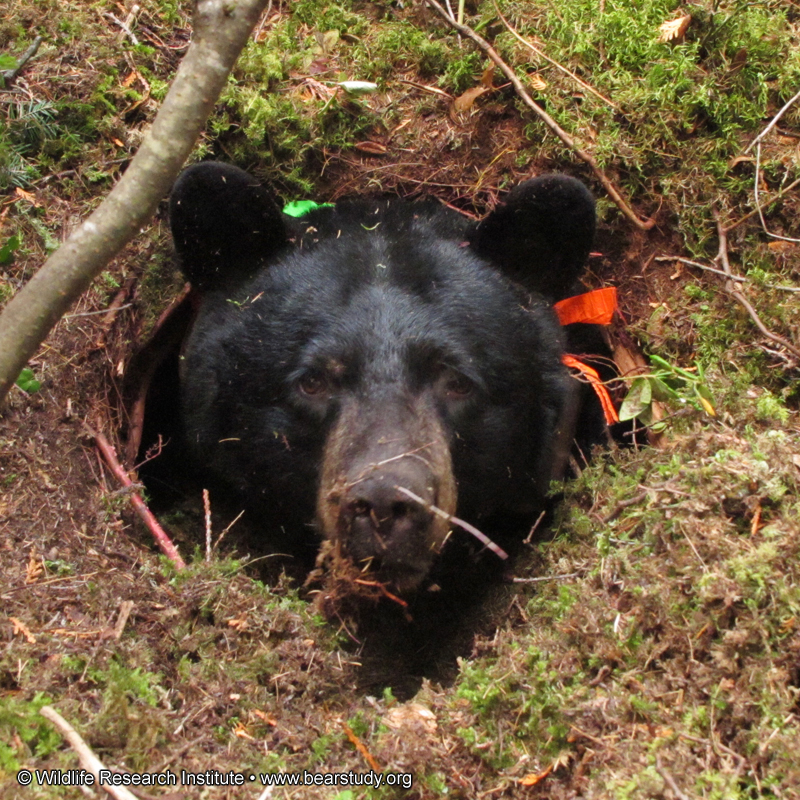 So we visited 10-year-old Dot. She is from Blackheart’s first litter back in January 2000 and is the cub Lynn lifted from Blackheart’s den in “The Man Who Walks With Bears.” Dot is also the 6-pound cub sleeping on Lynn’s lap in that documentary.
As Dot grew up, she dominated her smaller littermate Donna, but Dot had a rough time with another relative as a yearling after family breakup. Grandma Shadow let Dot know her boundaries and is probably the bear that bit Dot in the right foreleg causing her to limp badly for a couple weeks. She couldn’t put weight on the swollen leg for over a week. That was in early July. About a month and a half later, Dot became one of the few bears in Lynn’s decades of study to vacate her mother’s territory. When Lynn returned from Alaska at the end of August that year (2001), he found Dot starting a new life 3-4 miles to the east. She never returned to her mother’s territory.
That eastern part of the study area is the responsibility of Research Associates Glenn and Nancy Krause. They have monitored Dot these last nine years. They change her radio-collars, attach GPS units, and keep detailed records.
 Dot never forgot Lynn, though, even though the two would go months or years without seeing each other. Their mutual trust was tested in late winter and spring 2003 when Dot was in a den with her first litter. The BBC had called asking if there was anyone at the Wildlife Research Institute who could help them make a TV program using new breakthrough technology. They had a tiny camera that could record normal video and thermal imaging video. They wanted someone to place the camera under a nursing wild mother black bear to record thermal images of the nursing cubs. They said the new camera could provide unprecedented images for science, that the Wildlife Research Institute could have copies of the film to study, and that the program could help people coexist with black bears. They asked in an oblique way whether anyone at the Wildlife Research Institute was dumb enough to intrude into a den with a non-tranquilized mother and place the camera under her. Lynn said to come ahead.
The first attempt at placing the camera under Dot was in a blizzard. Lynn approached the den, saying “It’s me, bear.” Dot was calm. Lynn had to move away for a few minutes. When he returned, his green fleece jacket was covered with snow. He didn’t think to speak. Dot lunged out the den entrance in defense. Lynn spoke and held out his hand. Dot sniffed it and calmed down. She backed down onto her cubs, with Lynn following her into the den. When Lynn tried to work the camera under her, she lifted a leg to accommodate. The camera worked, and the scene, narrated by David Attenborough, is part of the Hibernation Exhibit in the North American Bear Center. See ‘Heat Loss in Dens.’
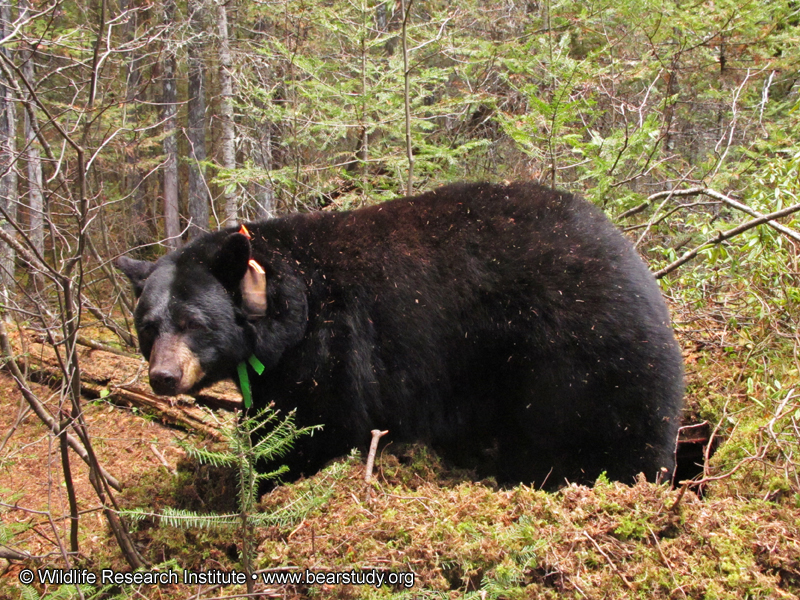
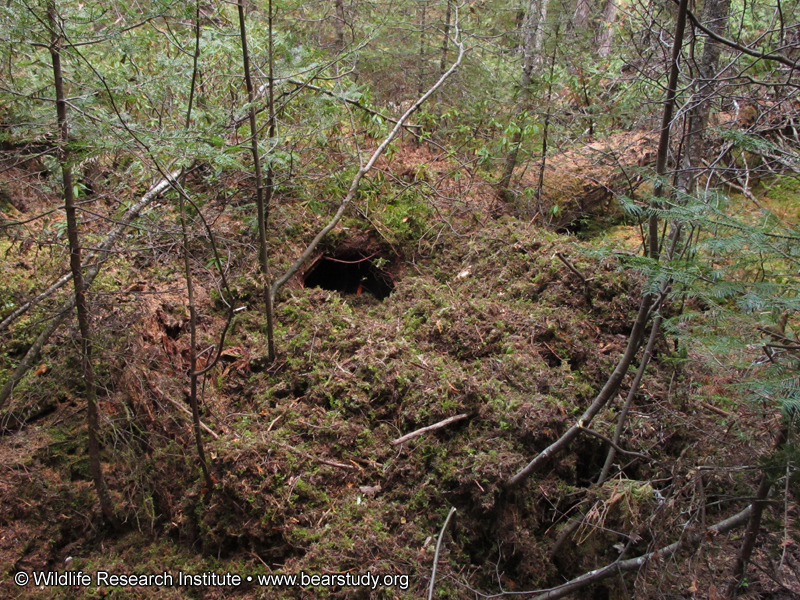 Today, Lynn wore the same jacket he wore on that visit 7 ½ years ago. He had not seen Dot for nearly two years. After a three quarter mile hike, we found Dot in the cushiest den we’ve ever seen. Dot had lined her den with deep moss for her cubs to snuggle into when they are born in January. And she might not be done yet. Mounds of moss lay by the den entrance. Lynn wasn’t sure Dot would recognize his voice and let him check her radio-collar after all this time. He wished Glenn and Nancy were along. Dot would certainly trust them to work on her.
Dot heard Lynn’s voice and came out showing no anxiety, but she balked when Lynn tried to twist her collar straight. The collar was plenty loose, but it didn’t twist easily for some reason. It was evident she didn’t appreciate the twisting, although she never said a bad word. What a sweetheart.
We went back to the Research Cabin to check when her GPS collar had showed her to be in this remote area. Dot arrived in the vicinity on September 8 and spent several days resting here and there like Lily is still doing today. On the last day before Dot’s batteries expired on September 12, she was within a tenth of a mile of her location today. From the large area that Dot has raked for moss, she has been at this remote den for weeks.
Dot is another bear whose loss would be a major blow to the study. Each year of data makes the research bears more valuable. Protection is needed. We’ve seen your well written letters. Now, following the good article in the Minneapolis Star Tribune that came out on Saturday, would be a good time for a round of letters to your legislators, the governor, and newspapers—especially the Minneapolis Star Tribune.
Thank you for all you have done and are doing. Together, we will gain protection for the study bears and continue their contributions to science, education, and Minnesota.
—Lynn Rogers and Sue Mansfield, Biologists, Wildlife Research Institute and North American Bear Center