
Something’s Happening
October 15, 2010 – 9:06 PM CDT
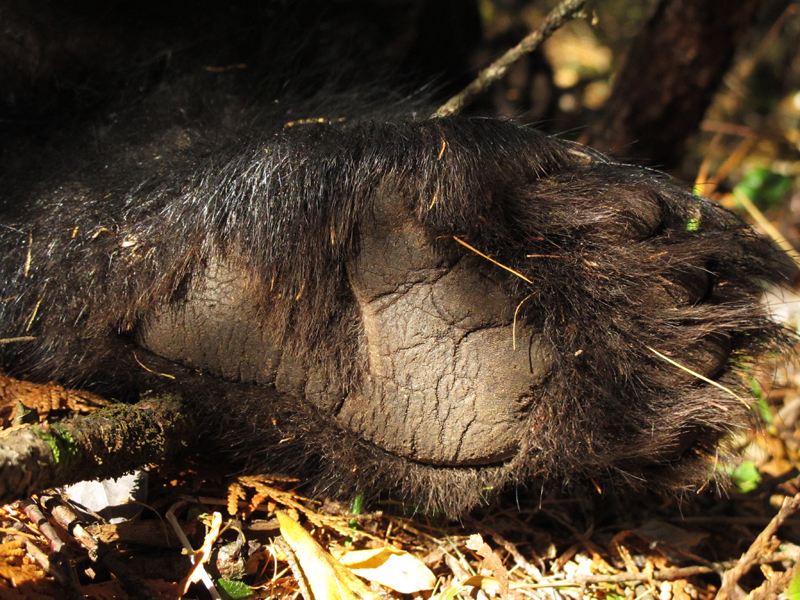 At 3:45 PM, Lily and Hope headed out from the area where they’ve spent the last several days. They moved 0.4 miles in the exact direction that would take them around the lakes and bogs to the den they made 1.9 miles away. They rested from 5 to 7 PM, and then moved another hundred yards and paused. Is this finally the beginning of their move to their den, or is it just another tantalizing movement like the others?
Braveheart might be in a den, but not the den she has been visiting periodically the last few weeks. The place she stopped last night very well could be an underground den. She stayed there overnight and through the day. There have been hours with no GPS signals when we suspect she is underground. We’ll check tomorrow.
With many bears denned up, practically no one in the study area sees bears. We did run into yearling male Ty (son of Bow) today. His heart rate was as high as ever. Two readings were 106 and 103. He was calm with Lynn, but while Lynn was taking his heart rate, Ty’s body would tense as he went on alert focusing on sounds in the darkness. He is the smallest yearling, which might be why he is still up. He weighs close to 200 pounds. For about a week—until about a week ago, he was hanging out with JJ, the yearling son of Shadow. Then JJ disappeared and most likely is at a den.
People are asking why bears hibernate and why they enter dens so early here. Hibernation is their way of surviving through the cold months of scarce food. The timing of hibernation is genetically programmed according to the regional norms of food availability. There are practically no fall foods in this region, so bears enter dens in September and October. In areas where there are acorns, hickory nuts, beechnuts, and other fall foods, bears are genetically programmed to hibernate later. Another regional difference is how black bears respond to warm spells in winter. Where there is virtually no chance of food being available in winter, like around here, bears remain in dens. Where there is a good chance melting snow could uncover nuts and acorns, bears often arouse, and some stay up somewhat active all winter. In Florida, most bears (except mothers giving birth in January) stay fairly active through winter.
Tonight, we viewed the rough cut of the BBC’s 1-hour film “Bearwalkers: From Fear to Hope.” It is a beautiful documentary of Lily and Hope’s lives from the time they left their den until the end of May. As expected, the BBC did a fantastic job of capturing the beauty of the area, the touching moments between Lily and Hope, and Gordon Buchanan’s journey from fear to fascination with these bears. Watching it, we re-lived the emotions of the break-up, the reunion, and more. The gripping story kept us quietly spell-bound and left us wanting more. If the next two documentaries are as good as this one, BBC has another winning series.
On another topic, we feel on edge all the time as tension mounts in the drive for legal protection for Lily, Hope, and the other radio-collared bears. Rumors to discredit us are flying. Officials are making veiled threats. Newspaper articles are being written in which writers try to balance the obvious good of this research and education with the worst rumors, the worst Facebook comments, and worst-case scenarios. They never have the space to tell details, so the public is often left with wrong impressions.
At the same time, Lily fans we meet in the North American Bear Center give us confidence that truth and justice will win in the end.
While things seem tense in some ways, we are also learning of important support. Also, we liked David Hoole’s story on Northland’s Newscenter 6 that aired a few days ago. He sent a new link to it today at http://www.northlandsnewscenter.com/news/outdoors/Lily-and-Hope-Ready-for-Hibernation-104729424.html, but you may have already seen it.
The commanding lead you created in the contest to vote $20,000 for Ely’s Schools held up today with a score of 2,683 votes to 869. The third place school received no votes and remained at 650 votes with 27 days to go. To vote, go to http://www.care2.com/schoolcontest/2704/054/.
Thank you for all you do.
—Lynn Rogers and Sue Mansfield, Biologists, Wildlife Research Institute and North American Bear Center