
Collar Swaps
Update 10-11-10 – 8:24 PM CDT
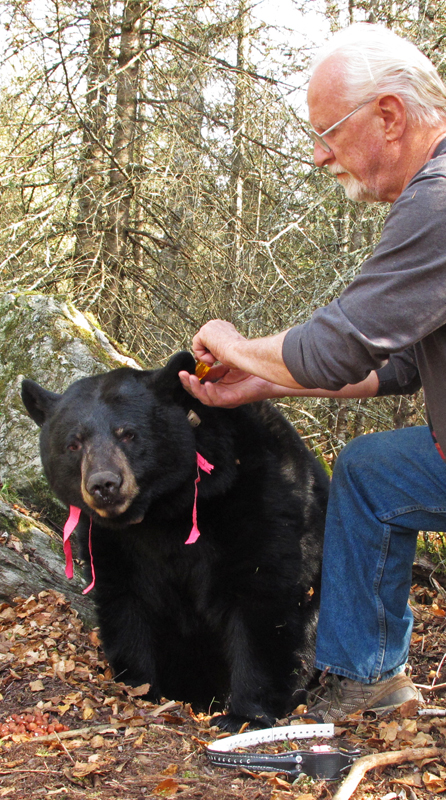 With Lily and Hope 1.6 miles southwest of the den they dug and showing no inclination to move towards it, we turned our attention to three other bears.
As part of our kinder and gentler research methods, and taking advantage of our ability to work closely with these bears without trapping and tranquilizing them, we are replacing their big radio-collars with thin ones for the winter. The batteries in these smaller ones will only last through winter and spring, but they are perfect for winter. The thin collar material allows the bears to more easily tuck their heads under their chests in the preferred hibernating position. These collars are like the one Lily wore last winter. Bears prefer to hibernate on their belly with hind legs forward along their sides and forelegs crossed with the head tucked under the chest. This minimizes heat loss from the muzzle and eye region and lets them re-breathe the warm, moist air they exhale into the bedding underneath them and along the sparsely furred underside. This becomes especially important after they give birth in January, the coldest month. Mothers have their heads tucked under, breathing on the cubs, minimizing heat loss and water loss. We don’t know another bear study that gives the smaller collars for more comfort in winter. Buying these radio-collars is one of the things we did with your donations.
Our first visit was to 9-year-old June (Lily’s mom). She was the first radio-collared bear to den up this year—on September 16. We haven’t visited June for nearly a month. She has been busy raking bedding from up to 50 feet from her den. She recognized our voices and came out and never said a bad word. She was perfectly calm. After changing her radio-collar (picture), we took her heart rate. Not surprisingly, it was the lowest we measured this fall—only 33. June is expected to give birth to two or three cubs in January. Seeing how June responded to us makes us want to redouble our efforts for protection during hunting season. She has known us for so long that her loss would be a huge blow.
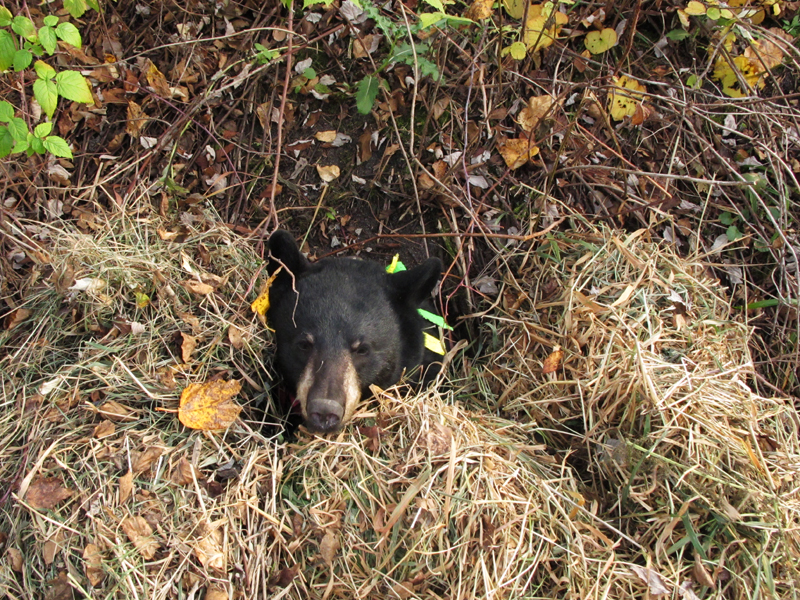 From there, it was on to 2-year-old Jo, who also may have cubs in January. She may have an unusually warm den this winter. She denned where there is a lot of tall grass, and she has raked big balls of it into her deep, dug den and also up to the entrance (pictures). We’ve seen other bears plug their entrances in these conditions, and her entrance was nearly plugged today. The opening in the grass was only about 6 inches in diameter, but she stretched that wider when she poked her head through it and then her body as she emerged. She brushed past us, looked around, watched an airplane, and then turned her attention to us. A few handfuls of hazelnuts gave us time to remove the old collar, give her a new small one, and take her heart rate—43, which is slower than it was (48) just before she squeezed into that small rock den a couple weeks back. Her current den is a classic dug den.
Jo is a natural sweetheart, which is almost unbelievable given our late exposure to her as a young bear. She is a daughter of prickly RC. We didn’t see much of her before she left RC at about 17 months of age. Slowly, on her own, she accepted our offerings and advances enough to allow herself to be radio-collared. But that was at a location where she was used to seeing people. It’s requires another level of trust to see a bear at other locations out in the woods. One day we got Jo’s signal near the town of Soudan. She was feeding in the powerline corridor that skirts the town. When she heard our voices calling out to her there, she didn’t believe it was us. She lifted her head and bolted.
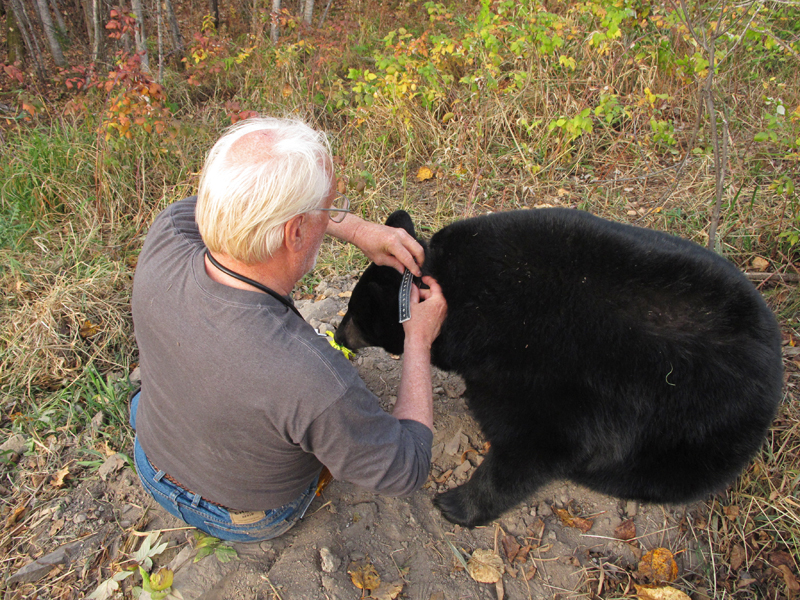 Later, we learned she was struck by a vehicle while crossing Highway 169. We feared the worst. We felt huge relief when we finally caught up to her a week later and she was okay. Today, she heard our voices, poked her head through the bedding that clogged her den opening and was totally accepting. She is another bear that we dearly want to see protected come hunting season. She has potential as a research bear we can follow.
The final bears of the day were Juliet and her three cubs Sharon, Shirley, and Boy Named Sue. As we approached their den in a cedar swamp, at first all we could see was a shadow with hot pink ribbons near the den. Next, we made out the GPS unit on the top of her collar. Finally, we saw Juliet herself with the three cubs near her. We distracted the cubs with hazelnuts and kept Juliet occupied with more of the same while we changed her collar and took her heart rate—48. Little Sharon and Boy also let us take heart rates. Cubs have faster heart rates than adults. Sharon’s was 68 and Boy’s was 72. This is a big drop from the heart rates in the 90’s only a couple weeks ago, which was a drop from the rates up around 160 earlier in the summer. It is likely that Sharon and Shirley will let us give them radio-collars in May before they leave Juliet. We probably won’t radio-collar Boy because of the high chance he will move far away. We’ll see what kind of GPS technology is available to us by then, though. (Sorry, no pictures of Juliet and cubs… ‘someone’ dropped the camera on the way in to their den. Fortunately we were able to locate it on the way out after considerable searching. )
Now, the wait continues for Lily, Hope and Braveheart to move to dens.
When we see how these bears behave and how that contrasts with the media hype about the danger from black bears, we yearn for honest programming with solid educational content and accurate information. That is one of the things that makes us thankful for the BBC’s willingness to portray black bears as they really are. One of these days, we’ll write an update on the topic. One of the things that spurs us in that direction is that we have been talking to Dr. Chris Palmer lately. He is the author of "Shooting in the Wild: An Insider's Account of Making Movies in the Animal Kingdom." You might have seen him on Nightline recently. We hope his exposure of some of the fraud behind TV programming about wildlife will lead to more honest portrayals for the public. We have often refused to be part of TV programs that mischaracterize bears.
That same thought is what drives our enthusiasm for the Education Outreach Project you and we are working on—and one of the reasons we want the research and education to continue long into the future with graduate students, biologists, and interns carrying on the mission.
Meanwhile, you are doing your part to make that possible with letters to officials asking for protection for the radio-collared bears and helping us any way you can. A couple days ago, you made life a little easier at both the WRI and the Bear Center with the gift of two super coffee makers from the Wish List. And you are continuing to keep Ely in a growing lead in the contest to bring $20,000 to Ely’s Schools. This further shows people the value of the radio-collared bears to the region—another point for protecting them from hunters. The latest score is 2,523 for Ely Schools to 636 for 2nd place. That’s only 21 votes short of a 4 to 1 lead. Thank you.
Thank you for all you are doing.
—Lynn Rogers and Sue Mansfield, Biologists, Wildlife Research Institute and North American Bear Center