
Ribbons for Lily and Hope
August 30, 2010 – 1:45 PM CDT
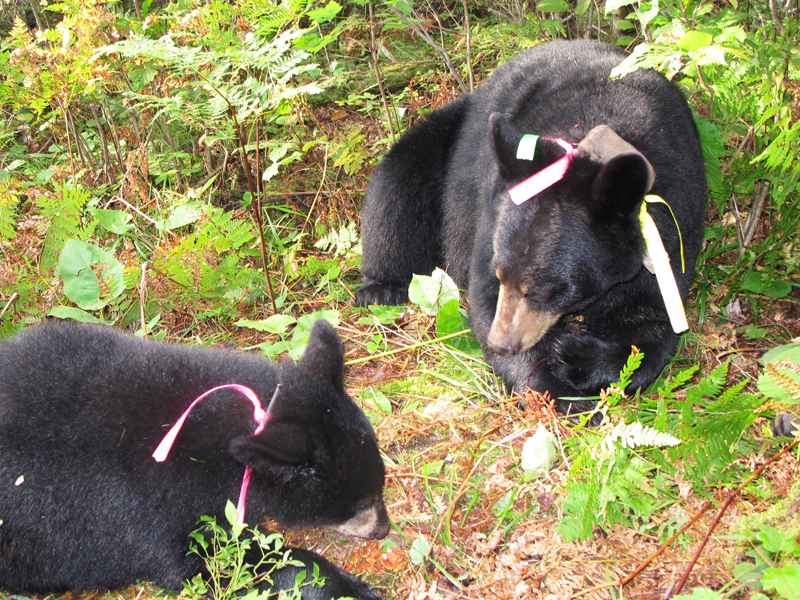 For Lily’s and Hope’s ribbons, we wanted to wait to as close to bear season as possible to minimize chances of them tugging on each other’s ribbons. A problem of a mother with a cub is that they investigate each other’s ribbons and often bite them short. When hunting starts in the dim light before sunrise on September 1, we want Lily and Hope to have maximum visibility. Today, we had to go ahead with the ribbons a day earlier than we wanted. They were headed into an area of difficult accessibility. We also changed the batteries in Lily’s GPS unit in case we can’t reach them in that area the next few days. Although it is good that they are heading into that area, we still worry because there are people who know obscure ATV trails for hunting those areas.
Lily’s heart rate was only 66 this morning—in contrast to previous heart rates of 74 to 83. Is she slowing down already on August 30th? She did seem pretty mellow. Hope was the usual fireball.
Mothers generally slow down before the cubs do, and it makes sense. As food becomes short, food that can make a meal for a cub would be too little for a mother. For example, the larvae in a hornet nest is a meal for a cub but only a mouthful for the mother. So, cubs sometimes go off to forage while mother rests.
But this difference in ambition between mothers and cubs usually doesn’t show up until later in September. Lily might be on the schedule of pregnant females that are the first bears to retire to their dens—often in early September and rarely in late August. If that is the case with Lily, hungry Hope is going to think she has an unusually lazy mother—and she could be right. We’ll see how much foraging Hope does in September and how well she does at keeping Lily active. It’s all part of what we are documenting.
Today, Hope gave us a scat filled with tiny bits of leaves—some clover but mostly jewelweed. We also found many holes an inch or two deep near where we found them. Around here, holes like that usually mean bears are foraging for june beetle larvae, roots of coral root orchids, or roots of jack-in-the-pulpit. We weren’t able to tell which in this case.
Now, we’re off to try to get ribbons on Jewel and Jo. We checked on Jo early this morning and she was miles down a gated road we don’t have access to.
Thank you for all you do
—Lynn Rogers and Sue Mansfield, Biologists, Wildlife Research Institute and North American Bear Center