
What will Lily do?
August 12, 2010 – 7:29 PM CDT
 Lily and Hope are foraging together in the area where they first separated on May 21.
We got the radio-collar and GPS back on Donna.
The rest of the day was tied up with paperwork, dealing with computer issues, and planning.
One thing planned is a meeting with engineers at 2 PM tomorrow. One is driving up from Minneapolis. The other is here from Indianapolis. They are both members of the team working on the best way to put Den Cams in dens far from electricity and telephone. The plan is to put a Den Cam in Lily’s den, which we expect her to share with Hope and a new litter when she gives birth (if she does, and she should) in January. The plan is also to put a Den Cam in the den of June, who should also give birth in January. We could then compare the care given by these two mothers and see how Hope fits into the picture in Lily’s den.
Then, come the usual time for family break-up in May-June next spring, we’ll see if Lily separates from Hope or allows Hope to stay with her to make up for leaving Hope this year. We know Lily’s not thinking in those terms, but it seems fair. If so, will Hope try to share the new cubs’ milk when it is nursing time? How will Lily react to that? Will she know it is not fair to the new cubs to give some of the milk to Hope? Or will she be a ‘Go along and get along’ kind of mom and just make more milk for all? How many cubs will she have this winter? Is she a mother that has smaller litters? Or will she meet the usual average? In a previous study, we found that first litters are typically 2 (13 litters out of 25) and subsequent litters are typically 3 (27 out of 45 litters). For the full data on that see page 53 of Wildlife Monograph No. 97 'Effects of food supply and kinship on social behavior, movements, and population growth of black bears in northeastern Minnesota.' Click on the title for a pdf of the full monograph..
However, there is another possibility. One mother that separated from her yearlings during mating season and then took them back later and denned with them did not produce any surviving cubs (or no cubs at all?) that winter. Might Lily not produce cubs? We’re guessing she will because mixed age litters have been reported, always with just one older cub. Did those mothers ovulate because one cub did not stimulate enough oxytocin and prolactin to prevent ovulation? Or did those mothers separate from their single cubs and mate like Lily did? Did some of the abandoned cubs survive and rejoin their mothers like Hope did? Many questions, few answers.
We’ll all learn whether Lily and Hope den together in less than 2 months. We’ll learn whether Lily will give birth in about 5 months. We’ll learn the rest of the story from the den cams and direct observation in the ensuing months.
All of this assumes these bears survive the hunting season—and we believe they will. Hunters begin baiting tomorrow in preparation for the hunt which starts September 1. We noticed extra 4-wheeler traffic in the study area today. Hunting guides will be asking their hunters not to shoot radio-collared bears, backing up our request and the DNR’s request to spare radio-collared bears.
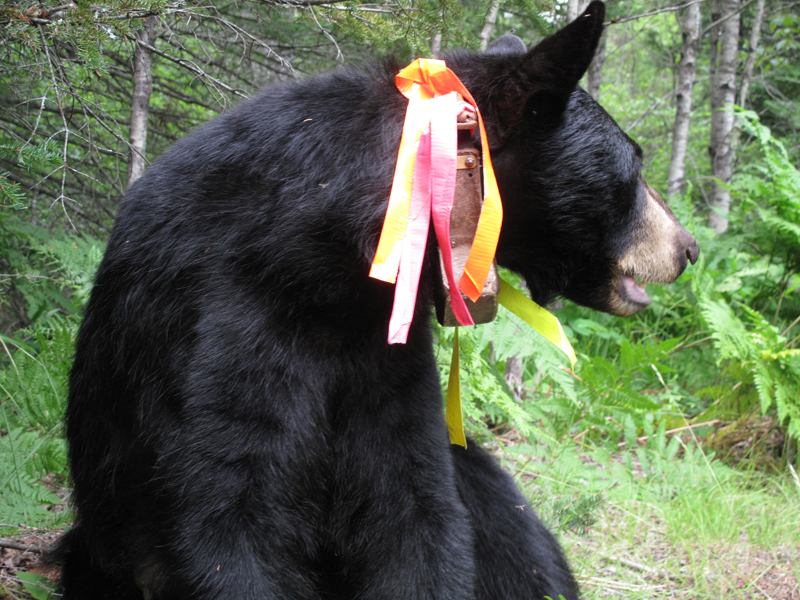
Very soon, we will put up signs throughout the study area alerting hunters to the presence of radio-collared bears. We will also tie multiple gawdy ribbons on the radio-collared bears. To see what the ribbons look like, check the MN DNR site at http://www.dnr.state.mn.us/hunting/bear/index.html and wait for the slide show to load. The picture above is June with ribbons tied to her collar.
Things continue to come together in the Education Outreach project. People are working hard.
Thank you for all you do.
—Lynn Rogers and Sue Mansfield, Biologists, Wildlife Research Institute and North American Bear Center